
Roofline integration is the detail that separates an addition designed as part of a home from one that can read as an afterthought, and it's almost entirely determined before the first board is cut. When the geometry is resolved early, when pitches are matched and transitions are engineered with the same precision as the rest of the project, the result is a home that looks as though it was always whole. If those decisions are deferred, the consequences tend to surface gradually – in a valley that holds ice through February, in a ceiling line that steps unexpectedly, in a profile that doesn't quite carry the same character as the structure it extends.
At O'Neill Bowes, roofline integration is one of the areas where our preconstruction process makes the most tangible difference on Cape Cod additions and renovations. The challenges are specific and recognizable. So are the solutions. This article walks through both, so that homeowners approaching an addition project understand exactly what needs to be resolved, and when.
The most successful additions on Cape Cod share a common thread: the roofline was resolved as a structural and aesthetic priority during preconstruction, well before design details firmed up and construction began. When that sequencing holds, the four challenges below become engineering decisions with clean solutions. When it falters, they become retrofit problems, more complex to address and more expensive to correct.
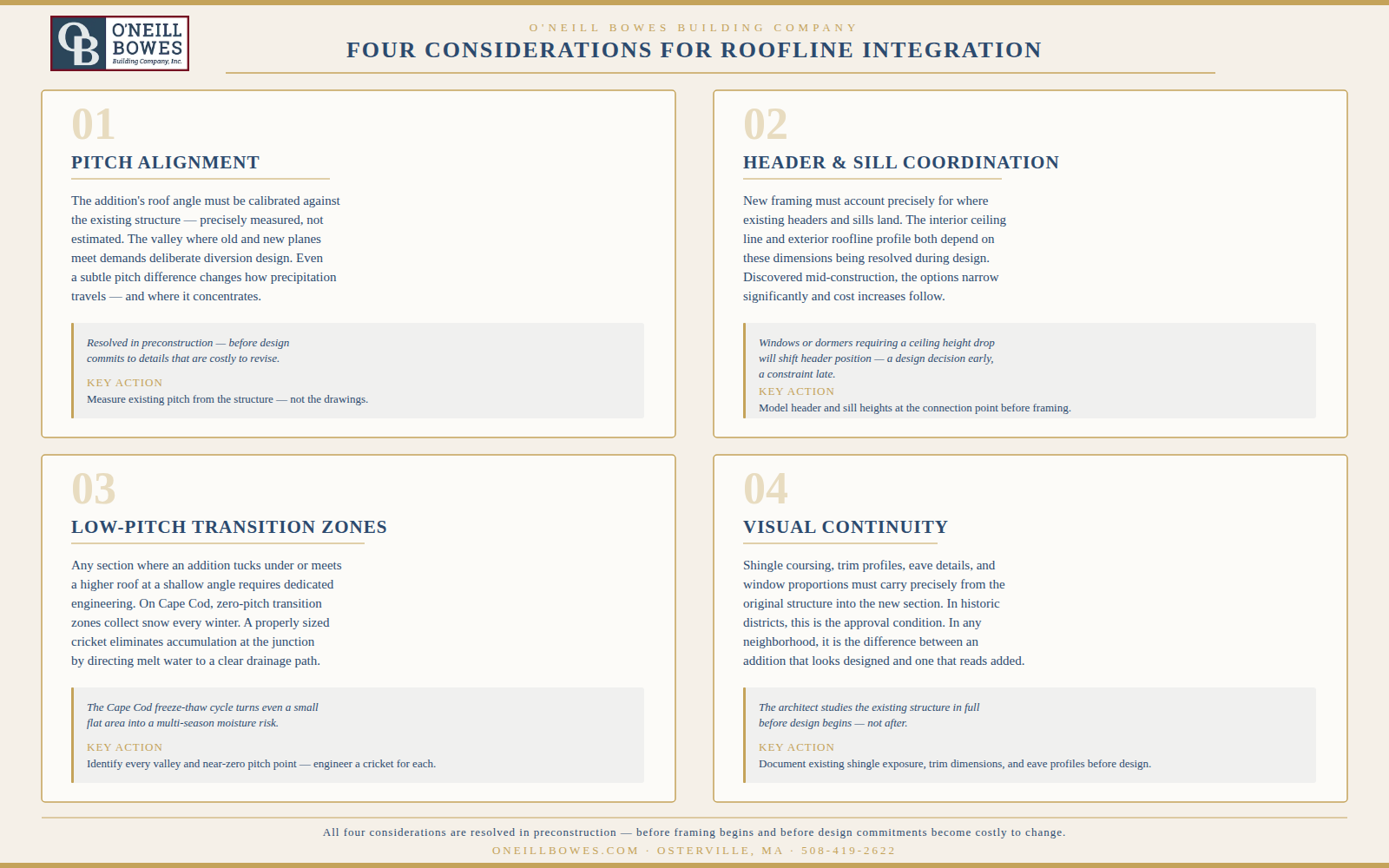
The first is pitch alignment. When an addition's roof angle differs from the existing structure, even subtly, the transition point requires careful engineering to manage water and snow movement. Mismatched slopes change how precipitation travels across the roof plane, and the valley between them demands deliberate diversion design rather than assumption.
The second is header and sill coordination. The new framing must account precisely for where existing headers and sills land. This extends to every window and wall penetration at the roofline intersection: one of the most consequential details in that zone is ensuring enough room for proper pan flashing and trim at each opening. Where a roofline meets a wall, windows and penetrations need adequate flashing depth at the intersection and sufficient clearance for trim to be installed correctly. When these relationships are resolved on paper before framing begins, the connection reads seamlessly, continuous ceiling heights inside, clean profiles outside. If they are discovered mid-construction, the options narrow.
The third is managing low-pitch transition zones. Any section where an addition tucks under or meets a higher roof at a shallow angle requires specific attention on Cape Cod. These areas are the first to accumulate snow and ice, and designing them well from the outset is far simpler than addressing ice dam damage after the fact.
The fourth is visual continuity. Shingle coursing, trim profiles, eave details: all of these carry the character of the original structure, and all of them need to be studied and matched before design is finalized. An addition that handles this well doesn't announce itself. It simply feels like the home it belongs to.
All four considerations are entirely manageable when they're addressed at the right moment in the process.
Cape Cod winters have a distinctive character that informs how rooflines on additions need to be engineered. Heavy wet snow, repeated freeze-thaw cycles, and nor'easters that deposit significant accumulation in compressed timeframes create conditions that reward careful roof geometry and penalize any section of the design that allows water or snow to concentrate rather than move.
The physics are straightforward. When a lower-pitched addition roof meets a steeper main roof above it, snow from the upper section travels down and collects at the transition. As temperatures cycle, the base layer melts and refreezes. Ice builds at the valley, at the eave, and at any point where drainage is restricted. Properly designed transitions, with appropriate pitch, well-placed crickets, and engineered diversion paths, manage this movement as intended. The water travels where it's meant to go.
What distinguishes the Cape Cod context is the cumulative effect of a season. A single storm is rarely the issue. It's the sequence (three nor'easters in six weeks, a warm spell in between, temperatures dropping again overnight) that tests roofline decisions made months earlier during design. Additions with well-resolved transitions perform through that sequence without requiring attention. The investment in getting the geometry right during preconstruction is repaid each winter, quietly and reliably.
This is why we treat valley design, pitch matching, and eave detail at the addition transition as structural decisions with long-term consequences, not finishing details to be resolved once framing is underway. Locking them in early is what allows the construction phase to proceed with confidence and the finished home to perform exactly as it should.
Pitch matching is the technical foundation of successful roofline integration, and it encompasses considerably more than aligning two angles on a drawing. What the architect needs to resolve, before design progresses past the schematic phase, is the full geometry of the connection: the precise pitch of the existing roof, the header heights and sill details at the point where old and new framing meet, the eave profile that carries from one section to the other, and how those elements converge at the ridge or valley where the two roof planes intersect.
Each of these details influences the others. A window or dormer introduced in the addition that requires a subtle drop in ceiling height will shift the header position, which in turn affects the exterior roofline profile. Managed early, that shift is a design decision with multiple clean solutions. Managed late, after framing has begun and dimensions are committed, it becomes a constraint that limits options and adds cost.
The architect leads this work. They study the existing structure in enough detail that the addition is designed from it rather than alongside it, understanding the actual pitch, the actual sill heights, the actual eave exposure, and translating all of that precisely into the new section. The result, when done well, is a roofline that reads as continuous rather than composed.
The builder's role begins where the drawings meet the site. Dimensions that are clean on paper occasionally require recalibration when framing reveals conditions that weren't fully visible during design. O'Neill Bowes treats that moment as part of the process, present early enough in preconstruction to flag anything that needs resolution before it becomes a field decision made under schedule pressure.
Among the more specific technical decisions in any Cape Cod addition or renovation project, and one of the areas where builder experience makes a meaningful difference, is the design of valleys and the placement of crickets at roof transitions.
A cricket is a small peaked diverter, typically built from framing and flashed with metal, installed at the point where two roof planes meet or where a vertical surface intersects a sloping roof. Their purpose is straightforward: redirect water and snow melt away from the transition point and toward a clear drainage path. When a new addition creates a valley, the inward angle where the addition roof meets the main roof, that valley needs to be designed with enough pitch to move water positively. A cricket positioned correctly at the base of that valley ensures that water arriving from above doesn't collect and sit.
The detail that deserves specific attention on the Cape Cod is the zero or near-zero pitch section. Any area in a roof transition where the slope effectively flattens, even briefly, even over a small area, becomes a collection point in winter. Snow accumulates there. It melts partially, then refreezes overnight. The cycle repeats across a full season. A properly sized cricket eliminates this by ensuring there is no flat spot for accumulation to begin.
What distinguishes this work is precision in sizing and placement. A cricket that is too shallow doesn't divert effectively. One that is oversized creates its own visual disruption and additional flashing complexity. Getting it right requires understanding the specific geometry of the addition and the drainage volumes involved, decisions that belong in the preconstruction and framing phase, not the finishing phase.
Cape Cod's architectural character is one of its most enduring qualities, and one of its most exacting standards. The shingled exteriors, consistent eave profiles, and quietly deliberate proportions that define homes across the region's historic districts and traditional neighborhoods are the product of generations of careful building. When an addition is planned, the expectation, from review boards, from neighbors, and from clients who chose this setting precisely for its aesthetic coherence, is that the new work is indistinguishable from the original.
That standard is achievable. It requires that the architect approach the existing structure as a primary source document before design begins.
Shingle coursing is where continuity is most visibly won or lost. The exposure, the amount of each shingle course left visible, establishes a horizontal rhythm across the entire exterior. When an addition matches that exposure precisely, the eye reads the facade as whole. When it doesn't, even by a modest margin, the transition announces itself. Skilled architects and builders use what amounts to an optical calibration – adjusting coursing slightly on taller sections to maintain the visual impression of consistency – a technique that is as much craft as calculation.
Trim profiles, window proportions, and eave details carry the same logic. Each element needs to be measured from the existing structure and carried into the new section with precision. In historic districts, this isn't a design preference, it's the approval condition. Review boards evaluate additions against the existing structure in detail, and applications that demonstrate thorough study of the original fare considerably better than those that approximate it.
O'Neill Bowes’ process begins with the architect documenting the existing structure fully (pitches, exposures, trim dimensions, window styles) before a single design decision is made for the addition. The result is an addition that earns its place rather than competing with it.
The roofline integration principles that govern a full addition apply with equal precision to covered outdoor structures, pergolas, cabanas, and outdoor kitchens that attach directly to the main house. The scale feels different, and the interior consequences of a misstep are less immediate, but the physics are identical. Where a covered structure meets the existing roofline, water and snow follow the same rules they always do.
A pergola or cabana attached to the rear of a home creates a roof transition at the connection point, typically where the new structure's roofline tucks under or meets an existing eave or wall. When that transition is engineered with proper pitch, appropriate flashing, and a clear drainage path away from the house, it performs through a Cape Cod winter without requiring attention. When those details receive less scrutiny than the main addition, the transition point becomes the same kind of vulnerability: ice accumulation, backed water, and eventually moisture intrusion at the connection.
We bring the same preconstruction rigor to outdoor structure attachments that we apply to full additions. The covered outdoor kitchen that becomes the centerpiece of a family's summer, and the pergola that frames the pool terrace, deserve the same engineering consideration at the roofline as any other part of the home they're connected to. The standard doesn't change because the structure is outside.
The decisions that determine how well an addition's roofline integrates with an existing home are all made before construction begins, which means the time to evaluate them is during the design and preconstruction phase, not after framing is underway. The following questions are worth raising directly with your architect and builder before those conversations close.
Has the existing roof pitch been precisely measured and documented? Not estimated from the drawings, measured from the actual structure. The addition's pitch needs to be calibrated against what is genuinely there.
Are header and sill heights modeled at the connection point? The interior ceiling line and the exterior roofline profile both depend on these dimensions being resolved before framing begins rather than during it.
Is there a valley or transition in the design that requires a cricket? If the addition creates any inward angle where roof planes meet, that junction needs an engineered diversion solution. The question of whether one is needed belongs in preconstruction.
What is the plan for the lowest pitch point in the design? On Cape Cod, any near-flat section in a transition zone is a winter maintenance consideration. Knowing where that point is, and how it drains, is a fundamental design question.
Has shingle coursing been drawn and matched to the existing structure? Visual continuity at the facade level requires that exposure measurements from the existing home be carried precisely into the addition's design documentation.
Has the historic district or neighborhood aesthetic been reviewed? If the property falls within a district with a review board, the addition's exterior details need to reflect that review's requirements before design is finalized, not after the application is submitted.
For O'Neill Bowes, these are standard preconstruction conversations. The homeowners who navigate Cape Cod additions most smoothly are the ones who arrive at the construction phase with every one of these questions already answered.
Roofline integration is where the quality of an addition's planning becomes visible, literally. The pitch alignment, the valley design, the shingle coursing, the cricket placement – none of these are finishing details. They are structural and aesthetic decisions that determine how the addition performs through every Cape Cod winter and how it reads from the street for the life of the home.
Our approach begins well before the first drawing is finalized. The architect studies the existing structure in detail. The roofline geometry is resolved at the schematic phase, not after framing has begun. The builder is present in preconstruction conversations precisely to catch anything that requires translation from drawing to site conditions before that translation becomes expensive.
The result is an addition that doesn't announce itself, one that carries the character of the home it belongs to, performs reliably through the seasons, and reflects the quality of planning that the project deserved from the beginning.
•••••
Planning a project on Cape Cod?
Call Nick anytime to discuss: 774.487.0475