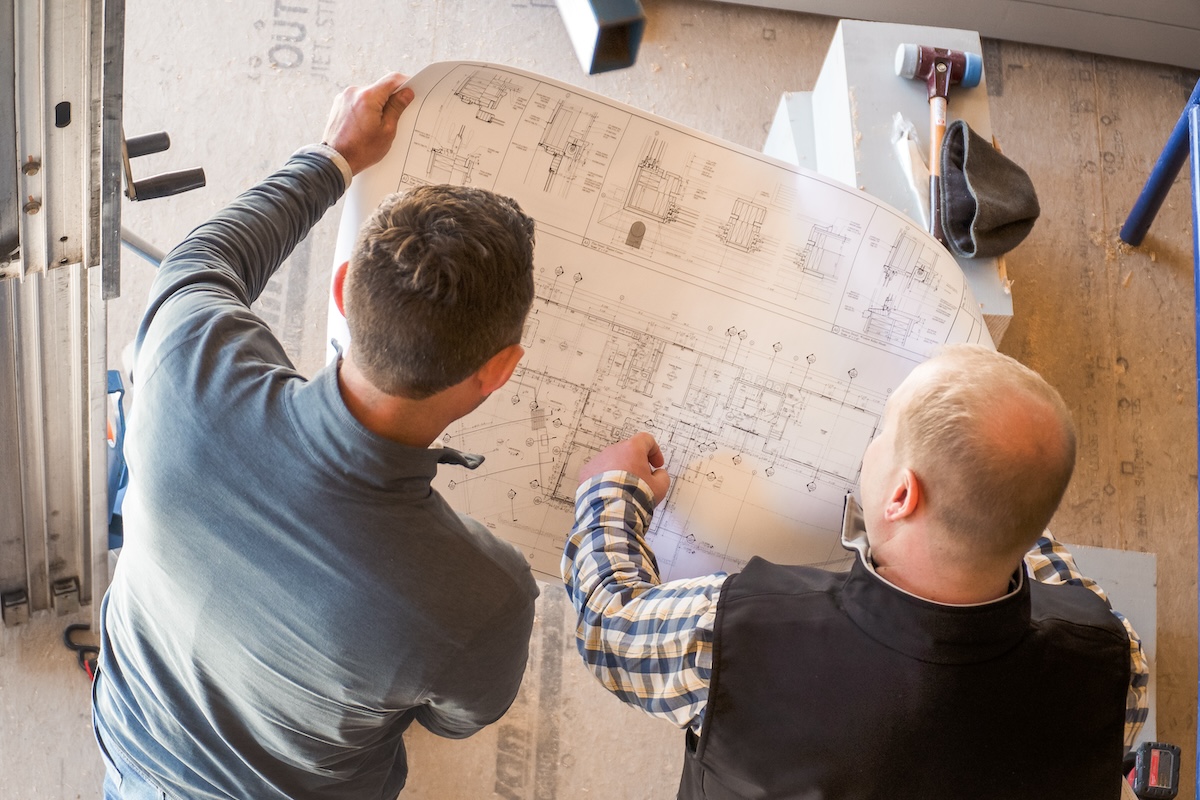
When clients sit down with the team at O’Neill Bowes Building before construction on their home begins, most of them expect to look over the plans. They end up taking a guided tour through the closest approximation to their home that’s possible without needing to wipe your feet.
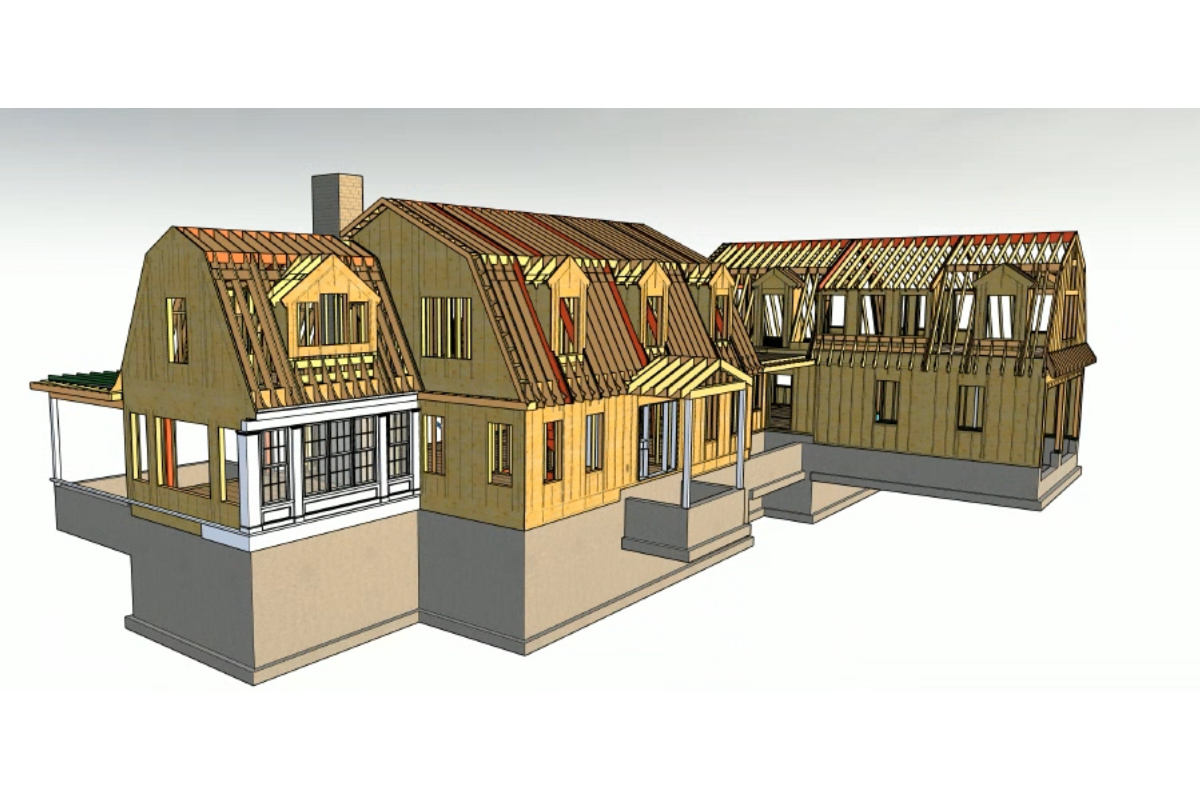
What OBB’s BIM (Building Information Modeling) Manager, Jim Stokes has been able to develop with the existing SketchUp software allows the client, the architect, the builders and everyone else down to the trim installers to see the actual structure, modeled in three dimensions. The roofline they’ve all been discussing, the drawn window proportions, and the spatial relationships between rooms that 2D drawings can describe but never fully demonstrate. Ceiling heights or the space between a counter and the stove are perceived much more as they will be so the client and their architect understand what they are approving because they can see it, not rely on their ability to interpret it.
Many builders working at this level in the residential market will show you, and work from, building plans. That’s the current industry standard and it’s worked for a long time: those plans are accurate and buildable. But a commercial market tool, like this 3D model, is unassailable and safeguards everything from internal framing and design to purchasing (accurate to the board foot).
What Jim’s been able to produce before a permit is filed is a fully resolved model of the structure, built in a proprietary environment he developed over twenty years in the field. How he built it, and what it means for a project, is what we’re excited to elaborate on here.
SketchUp is a professional 3D modeling platform used across architecture, construction, and design. It's widely adopted, visually intuitive, and capable of producing detailed representations of buildings and spaces before anything physical exists.
For architects, it's a useful design communication tool, a way to show clients what a home might look like from the street and establish a shared visual reference early in the process. In residential construction, most firms use it for concept-level work: early massing studies, basic volumetric forms, exterior renderings that give a client a general sense of scale and proportion. That's a legitimate and valuable use of the software, and it's where most residential applications of SketchUp stop.
What Jim has built at O'Neill Bowes sits downstream of the architect's design work and runs parallel to it. Where the architect is developing and communicating the vision, Jim is translating that vision into a fully coordinated construction model, one that goes well past the exterior massing and into every structural member, connector, and cut inside the building. The two bodies of work are complementary. Architects who have worked with OBB's models find that the coordination work Jim produces makes their own workflow more efficient, surfacing constructability questions early and resolving them before they affect the design.
Jim Stokes does not use SketchUp the way it was shipped. What he's built with it is something the software has yet to be marketed to do.
Standard SketchUp requires you to work on things one piece at a time. Draw a wall. Draw the next wall. Draw each rafter, individually. If something changes (a ceiling height, a roof pitch, a structural dimension), you step back and update every dependent element, one by one. For a simple structure that's a manageable limitation. For the complex, multi-plane rooflines that define high-end residential work on Cape Cod, it created a problem Jim found too inefficient to work around.
Jim had been framing roofs by hand since 2005. By the time he started developing his SketchUp environment he had twelve years of job-site experience behind him, and he understood exactly what a modeling error cost in the field. Not as a software inconvenience, but as lumber cut to the wrong length, as a bastard hip that doesn't marry cleanly, with a crew standing on a deck while someone works out a problem that could have been solved at a desk. That knowledge made the limitations of standard SketchUp untenable at the level he works.
So he built what the software didn't have into the software itself. The most significant modification was parametric cascading, a feature standard in high-end commercial platforms like Revit but absent from the out of the box model of SketchUp. With Jim's version, changing one element updates every dependent element automatically. Move a wall and the roof structure adjusts. Change a pitch and the rafter lengths, ridge heights, and valley angles all recalculate. He also built-in the ability to enter a roof plane's dimensions and have the software auto-populate the full rafter layout to spec, with material outputs calculated to the board foot. The model tells you what to order and how to cut it, before anyone sets foot on the site.
What Jim runs today is less a modified version of a consumer tool than a purpose-built pre-construction environment developed over years, informed by two decades of field experience, and designed to do something the residential construction market has rarely seen.

Sitting down with this model, what they’re looking at is not a rendering, it's a fully resolved version of a home, color-coordinated by system, with walls distinguished from floors distinguished from structural members, every component present and accounted for. The model is navigable in three dimensions. Ceiling heights read as ceiling heights. Spatial relationships between rooms are visible rather than implied. Clients understand what they're approving because they can almost experience it, and when they want to change something, they change it at a desk with their architect and their builder before construction begins, where the cost of that change is essentially zero.
The decisions that get made in preconstruction are the ones that matter most. Where a kitchen island lands relative to a structural column, whether a hallway reads as generous or tight once the ceiling height drops, how a roofline condition affects the interior volume of a second-floor room, or whether a window placement works with the wall framing or creates a conflict. These are all questions that 2D drawings leave open without marked experience, not because the architects aren't doing their jobs, but because the third dimension is where those answers live and 2D drawings can't communicate that reality to a client the way a navigable model can. Jim's model, developed in direct collaboration with the design team, puts those answers on the table before construction begins.
On a recent project, a client and their architect came in to review a home that looked straightforward from the outside. Inside the model it was significantly more complex, with a substantial number of structural members intersecting throughout. Jim had already flagged and resolved several interferences and framing collisions, conditions that would have appeared as problems on the job site, under time pressure, with crews waiting. Every one of them was sorted out at the desk. The first shovel hit the ground under a resolved set of plans.
That's what this level of pre-construction coordination produces: fewer surprises, better information for decision-making, and a client who walks into their finished home to find exactly what they approved.
Ultimately, this process and what it’s able to achieve and protect against, has less to do with the software than the operator. What O’Neill Bowes Building collectively brings to the tool when they sit down to use it is the determining factor: decades of experience framing houses by hand before ever opening the program, and the specific knowledge that accumulates in Tim, Nick, Jim, and Alec, who have all spent years building the thing they are now able to “draw”.
When Jim models a structural connection, he has made that connection with his hands at some point over the last 20 years. He knows how it will behave under weight, where the vulnerability lives, what it looks like when it's executed correctly and what it looks like when it's not. He knows that a kiln-dried joist will move as it dries, that an engineered I-joist carries a compaction factor, that an LVL beam is dimensionally stable in ways the others aren't. Those distinctions now live in the model. They inform where things land, how tolerances are set, and how details and challenges are resolved.
In practice, that means he can look at a 2D plan and identify immediately where the collisions are, where the dimensions won't survive contact with real materials, where a doorway needs to move or a stair needs to shift to accommodate what the 2D doesn't show. That read is instant for Jim in a way it cannot be for most people, who have not stood on a job site and built what they are looking at time after time. It's also why the architects and engineers OBB works with find the coordination process productive, not redundant. Jim isn't second-guessing the design, he's translating it into what can be built exactly as intended.
That combination of field experience and technical fluency is what makes this capability genuinely difficult to replicate.
What’s built in Jim's model before a nail is driven is not a visualization service or a presentation tool: it is the first stage of construction. The interferences caught, the conditions resolved, the decisions made while they're still free to make, these are as consequential as anything that happens after ground breaks. When the framing crew arrives on site, they are not problem-solving – they are working from a resolved set of plans, executing on decisions that have already been made, reviewed, and signed off on by all the stakeholders at the table.
The roof can be confidently cut on the ground. The collisions have already been identified. In one recent project, the modeling process caught upwards of thirty individual issues before framing began. Resolving those on a job site, mid-construction, would have added an estimated six weeks of rework. At the cost of custom residential framing on Cape Cod, that is a number that lands hard.
For clients, what this means is straightforward. When you walk into your finished home for the first time, there should be no gap between what you imagined and what you find. As Jim puts it: "You will not be surprised when you walk into your new home. There is no way to get closer to the real thing without having keys."
That is the standard we hold ourselves to at O'Neill Bowes. And it is where every project begins.
•••
Planning a project on Cape Cod?
Call Nick anytime to discuss: 774.487.0475
BIM modeling at O'Neill Bowes is not a visualization tool or a presentation nicety. It is the first stage of construction, producing a fully resolved model of every custom home before a permit is filed.
Jim identified two fundamental limitations in standard SketchUp that were untenable for the level of precision OBB's projects require, and built solutions for both directly into the software.
Jim's modeling work is designed to complement the design team's work, not compete with it. The two bodies of work address different phases of the same project and are stronger together than either is alone.
The experience of reviewing Jim's model before construction begins is qualitatively different from reviewing a set of plans. It changes what clients understand, what they decide, and how confidently they move into the build.
Twenty years of framing houses by hand is not a credential that decorates Jim's title. It is the operating system behind every model he builds, and it is what makes OBB's pre-construction environment genuinely difficult to replicate.
The modeling work Jim produces before ground breaks changes the character of everything that follows. The build runs differently because the decisions that normally surface as problems have already been made as choices.