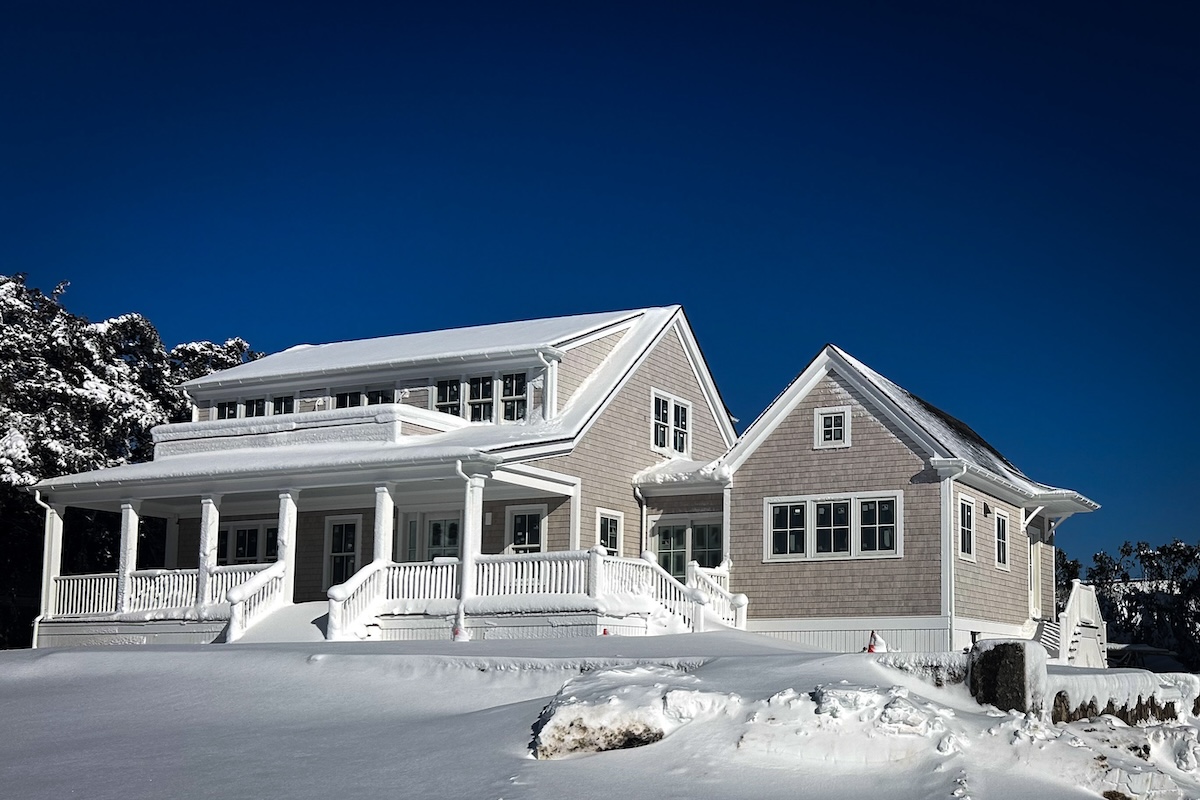
Most decisions about a Cape Cod renovation are made in good weather. Homeowners walk the property in June, meet with builders in July, and choose materials from showroom samples while the sun is out and the air smells like the ocean. That's when Cape Cod is at its most persuasive, and when expensive mistakes can be made.
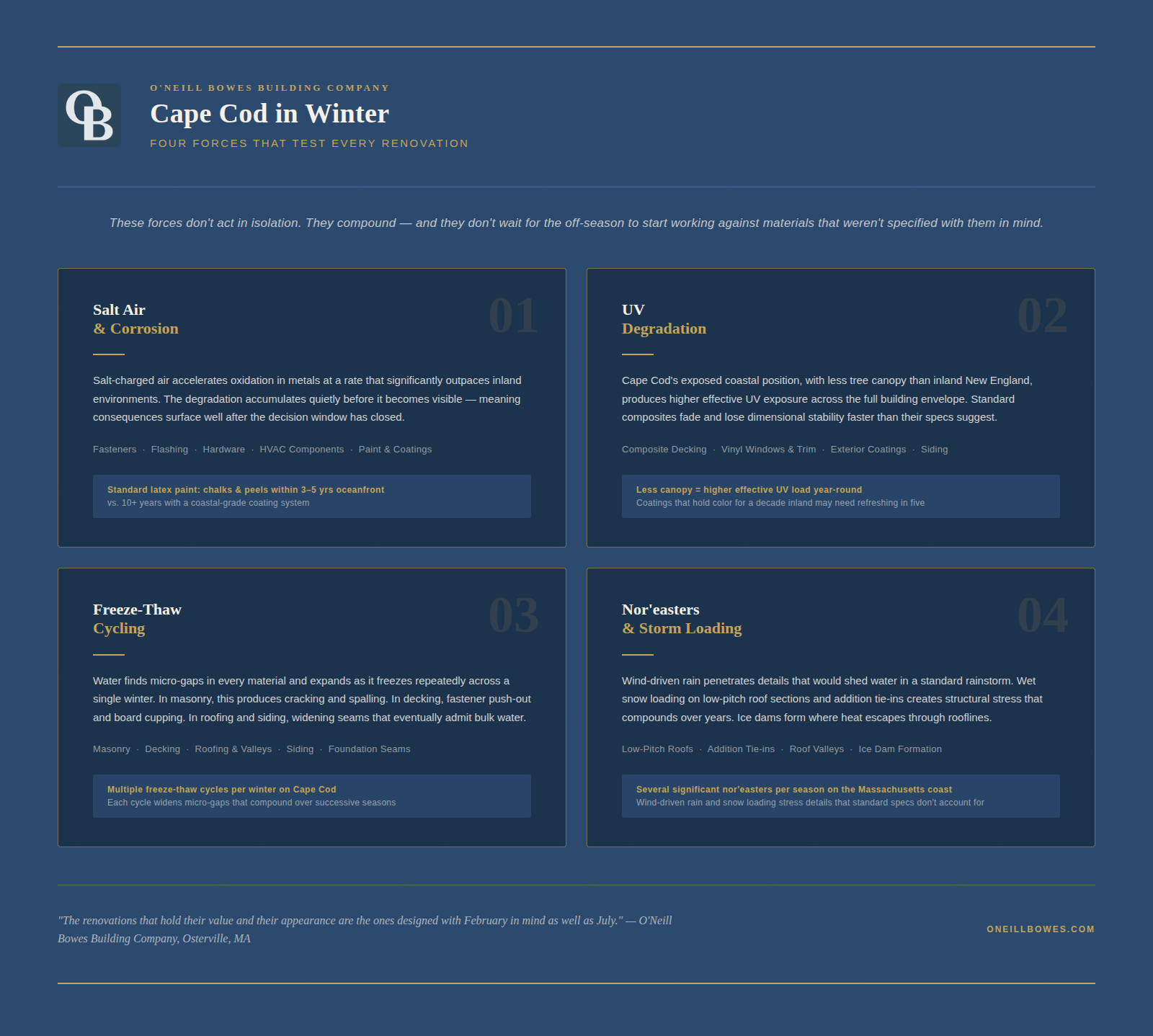
The home they're renovating doesn't only live through Labor Day. It lives through February nor'easters that drive salt-charged rain sideways at 60 miles per hour. It lives through freeze-thaw cycles that work water into every seam and gap and expand it until something gives. It lives through ice dams that back up under rooflines, UV exposure that breaks down coatings and composites faster than any inland location, and a salt air environment that corrodes standard metals, degrades standard paints, and shortens the lifespan of systems that would perform fine somewhere else.
Cape Cod renovation durability isn't a premium feature. It's the baseline requirement for any project that's meant to last. These environmental forces don't act in isolation. They compound. And they don't wait for the off-season to start working against materials that weren't specified with them in mind.
After 25+ years of combined high-end construction on Cape Cod, O'Neill Bowes has learned that the renovations that hold their value and their appearance are the ones designed with February in mind as well as July.
Cape Cod presents a specific set of environmental conditions that work against buildings in ways most inland construction never encounters. Understanding what those forces actually do, mechanically, is what separates material and system choices that last from ones that require premature replacement.
Salt-charged air accelerates oxidation in metals at a rate that significantly outpaces inland environments. Fasteners, flashing, hardware, and HVAC components that carry standard warranties in Worcester or Springfield are on a meaningfully shorter timeline within a mile of the water. Standard latex paints begin to chalk and peel within three to five years on oceanfront exposures. Adhesives break down. The degradation tends to accumulate quietly before it becomes visible, which means the consequences often surface well after the decision window has closed. Exposure level matters considerably here. An oceanfront property in Chatham faces a different salt load than a mid-Cape home set back from the water, and material specifications should reflect that distinction.
Cape Cod's exposed coastal position, with less tree canopy than inland New England, produces higher effective UV exposure across the full building envelope. Standard composite decking fades and becomes brittle faster. Vinyl windows and trim lose dimensional stability sooner. Coatings that hold color for a decade elsewhere may need refreshing in five.
Water finds micro-gaps in every material, and on Cape Cod it freezes and expands in those gaps repeatedly across a single winter. In masonry, this produces cracking and spalling over time. In decking, fastener push-out and board cupping. In roofing and siding, widening seams that eventually admit bulk water into the assembly.
The Massachusetts coast averages several significant nor'easters per season, with wind-driven rain penetrating details that would shed water in a standard rainstorm. Wet snow loading on low-pitch roof sections and addition tie-ins creates structural stress that compounds over years. Ice dams form where heat escapes through rooflines, backing water up under shingles and into wall assemblies in ways that aren't always immediately apparent from the interior.
Where we see the most premature failure on Cape Cod renovations, and what we specify instead.
Roofing is where Cape Cod winters extract the most damage, and ice dams are the primary mechanism. When heat escapes through the roofline, it melts snow at the surface, which refreezes at the cold eaves and backs water up under shingles and into the wall assembly. This risk is highest at low-pitch sections, valley intersections, and addition tie-ins where two rooflines meet at an angle. What we specify: ice-and-water shield underlayment across the full vulnerable area, not just at the eaves. Proper attic ventilation to reduce the heat differential that creates dams in the first place. Copper or stainless flashing at every penetration and valley. Galvanized flashing has a limited service life in a salt-air environment and tends to fail quietly before anyone notices.
There is no single correct siding material for Cape Cod, because exposure level varies significantly across the peninsula. Cedar shingles remain the regional standard for good reason. They perform well in coastal conditions, age gracefully, and hold paint and stain better than many alternatives when properly maintained. Fiber cement is a strong performer at mid-Cape exposures where salt load is moderate. Standard composite products, and particularly standard latex paint systems, are where we see early failure on oceanfront properties, with chalking and peeling beginning within three to five years. Coating system selection matters as much as the substrate. A premium paint system on a well-prepared cedar surface will consistently outlast a standard system on any material.
Outdoor living spaces tend to be where the gap between summer specification and year-round performance becomes most visible. Standard cabinetry warps. Standard hardware rusts. Appliances specified for interior or mild-climate use show peeling finishes and seized components within two to three seasons of coastal exposure. What holds up: marine-grade stainless steel for hardware and appliance panels, powder-coated aluminum frames for cabinetry and structure, and weathered granite for countertops, which handles thermal cycling and salt exposure without the maintenance burden of other stone options. The outdoor kitchen is often the first place a homeowner who built for summer encounters a repair bill that a different specification would have prevented.
Mechanical systems are where specification-decisions made during a renovation compound most significantly over time. Salt air degrades exterior HVAC components, electrical panels, and fixtures at an accelerated rate, and equipment not rated for coastal exposure will require earlier replacement. Heat pump systems, increasingly common as Massachusetts energy codes evolve, need cold-climate rated equipment to maintain efficiency through Cape Cod winters rather than losing capacity precisely when demand is highest. Conduit placement and the installation of supplemental conduit runs during an active renovation, a relatively low cost at the time, can save significant expense when systems need upgrading later. Mechanical placement decisions are among the hardest to revisit after a project closes.
The most important durability decisions on a Cape Cod renovation are made before construction begins, or they are made by default. Material specifications get locked in at the design phase. Once a project is framed, sided, and roofed, revisiting those choices could mean tearing out work. The window for getting it right is early, and it can close faster than most homeowners expect.
This is where the conversation shifts from materials to process. Experienced builders who have worked on Cape Cod for years develop a different set of reference points than builders whose experience is primarily inland. The question they bring to a specification decision isn't whether a material performs well in general. It's whether it performs well here, under these conditions, over a ten to twenty year horizon. Those are different questions with meaningfully different answers.
Homeowners who have renovated successfully elsewhere are sometimes the most surprised by this distinction. A product line they've used successfully on a Connecticut shoreline property or a mountain home in Vermont may carry a strong reputation that doesn't fully translate to oceanfront Cape Cod exposure. The salt load is different. The freeze-thaw frequency is different. The UV profile is different. A builder's job, in part, is to bring that local context into a conversation that might otherwise be driven entirely by what looked compelling in a showroom or performed well somewhere else.
The financial framing matters here as well. Specifying up on materials and systems at the design phase carries a cost premium that is almost always lower than the cost of replacing a system or finish that wasn't specified for its environment. A marine-grade hardware package costs more than standard grade. It costs considerably less than refinishing and re-hinging an outdoor kitchen two seasons after it's built. The durability premium, approached honestly, is a financial decision as much as a quality one.
O'Neill Bowes' approach is to present that tradeoff transparently, with specific options and real cost comparisons, and let the client decide with full information. In practice, clients who understand what the environment will do to a standard specification nearly always choose to specify up. The ones who don't occasionally come back having wished they had.
These are the questions worth asking before specifications get locked in, organized by the type of work you are planning.
Verify that cabinet materials and construction are rated for high-humidity coastal environments, not just interior residential use. Confirm hardware is marine-grade stainless or solid brass. Specify appliances with stainless exteriors rather than painted or coated panels. If the kitchen has any exposure to exterior air through ventilation or an attached outdoor space, treat the material standard as you would an outdoor installation.
Specify marine-grade stainless for all hardware, fasteners, and appliance panels. Use powder-coated aluminum or teak for structural framing and cabinetry. Choose weathered granite or porcelain for countertops over materials that require sealing or show thermal stress. Confirm that any covered structure is designed with Cape Cod snow and wind loading in mind, not standard residential assumptions.
Install ice-and-water shield underlayment well beyond the minimum code requirement. Require copper or stainless flashing at all penetrations, valleys, and addition tie-ins. Match siding specification to your actual exposure level: oceanfront, bayside, and mid-Cape properties have meaningfully different salt loads and should not be treated identically. Confirm that your coating system is specified for coastal exposure, not standard exterior use.
Specify cold-climate rated heat pump equipment if you are moving to a heat pump system. Confirm that exterior HVAC components and electrical fixtures are rated for coastal environments. Install supplemental conduit runs while walls are open, even if the systems they would serve are not part of the current project. Verify that equipment placement accounts for salt air exposure and allows for service access without requiring finish work to be disturbed.
The renovations that hold their value on Cape Cod are not necessarily the most elaborate ones. They are the ones that were specified with the environment in mind from the beginning. Durability isn't a constraint on good design. It's the standard that good design is measured against out here, in a way that simply doesn't apply the same way anywhere else.
O'Neill Bowes brings 25+ years of combined high-end construction experience on Cape Cod to every project. No imposed style, no preferred material list, no signature aesthetic. What we bring is local knowledge of what lasts, a transparent process for presenting real options and real tradeoffs, and a commitment to keeping clients informed at every decision point.
If you are planning a renovation and want to understand what year-round durability should mean for your specific project, we would welcome the conversation. There is no pressure and no obligation. Just an honest discussion of your goals and what the environment will ask of them.
•••••
Planning a project on Cape Cod?
Call Nick anytime to discuss: 774.487.0475