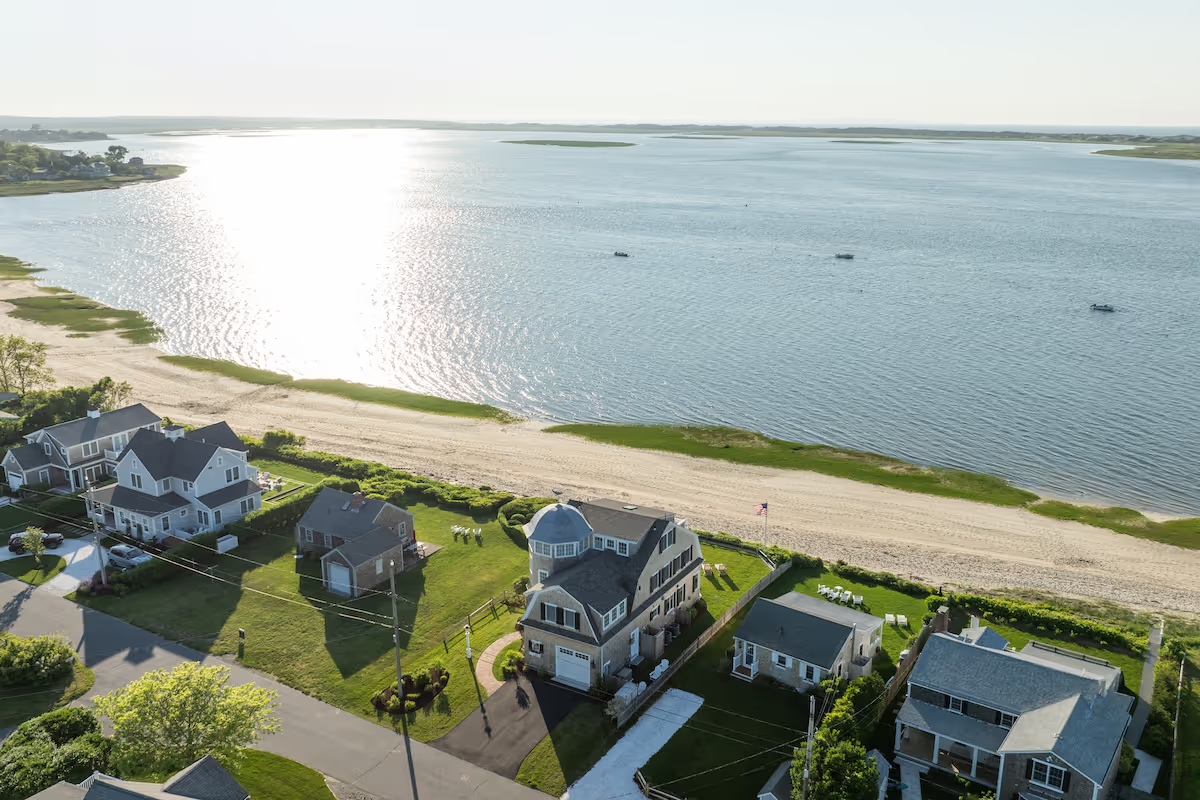
Preparing to build on the Cape Cod waterfront is a different category of pre-construction than prepping to build inland, and the gap between the two is wider than many clients could expect, particularly if they’ve either only built inland or have never built a home before at all.
The regulatory environment is far more layered, the soil conditions are less predictable, the material specifications more specific, and the timeline harder to control from the front end. Many of the factors determining whether a waterfront project will go smoothly are almost all made before a shovel breaks ground, in preconstruction. That’s where the complexity lives.
What follows is an honest overview of what waterfront construction on Cape Cod actually involves: what makes it different, where the pressure points are, and what clients who are thinking about building or rebuilding on the water should be expecting going into the first conversation.
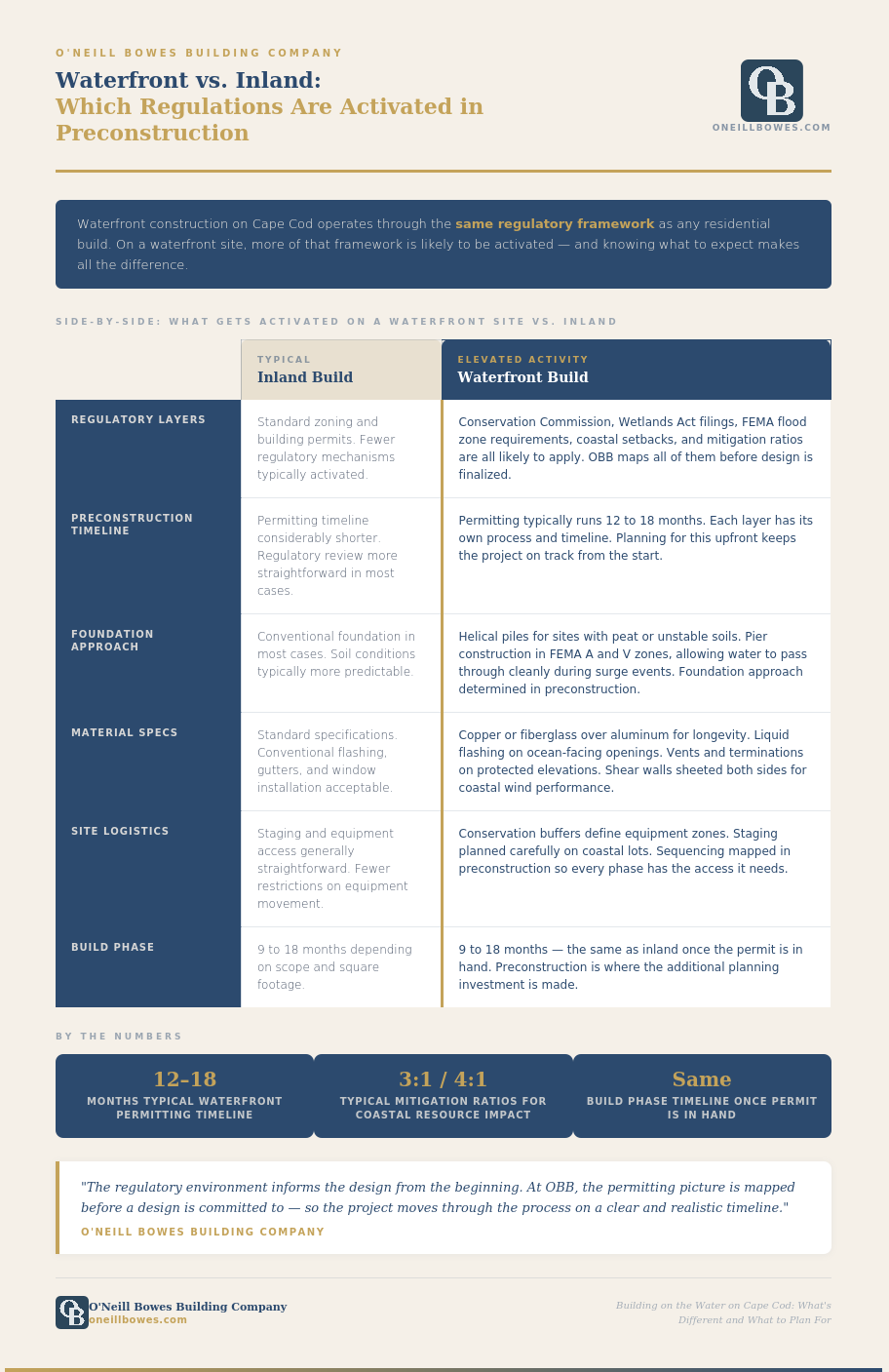
The permitting process for a waterfront project on Cape Cod operates through the same regulatory framework as any other residential build. The difference is how much of that framework gets activated and put into play.
Conservation Commission review, Wetlands Protection Act filings, FEMA flood zone requirements, coastal setbacks, mitigation ratios … these mechanisms exist for inland projects too. On a waterfront site, more of them apply, they apply more extensively, simultaneously. A project that triggers one or two of these inland might trigger all of them on the water, each with its own timeline, its own conditions, and its own opportunity for the unexpected.
That's what extends the front end of a waterfront project. Not a different process, but so much more of the same process running in parallel. Having the right civil engineer and surveyor engaged early, understanding each town's specific setback requirements and mitigation ratios, and knowing how to work effectively with conservation commissions are what determine whether a project moves through that process efficiently or gets held up in it.
At OBB, the regulatory picture gets mapped before the design is finalized. There is no value in developing a site plan that will require significant revision once the conservation filing is reviewed. The regulatory environment informs the design from the beginning, which is the only approach that keeps the project on a realistic timeline.
The preconstruction & permitting phase on a waterfront project can take considerably longer than clients who have built inland might expect. That timeline is worth understanding going in, because it shapes the schedule of everything that follows.
Coastal soils on Cape Cod are not uniform and they’re not always what they appear to be from the surface. Peat deposits, man-made fill, unstable bluff material, or high water tables are all common enough in waterfront settings that a geotechnical assessment is a standard practice in preconstruction rather than an optional practice. What's under the ground shapes every foundational decision that follows.
On one recent project in Mashpee, the site appeared straightforward until the ground was opened and peat was discovered beneath the surface. Peat is compressible and unstable as a bearing material, which meant a conventional foundation was off the table. The solution was helical piles: steel screws driven deep into the ground to refusal, then filled with concrete to create stable footings independent of the compromised soil above. It's a reliable approach when the conditions call for it, but it's also one that adds cost and time that a surface assessment alone could not have anticipated.
FEMA flood zone designations introduce another set of foundation requirements on waterfront sites. In A zones and V zones, where wave action and surge are planning factors, conventional foundations may not be permitted at all. Pier construction becomes the required approach, allowing water to pass beneath the structure during a surge event rather than building shear force against a solid foundation. The distinction between zone types determines which parameters apply, and those parameters are established in preconstruction before a foundation design is finalized.
What's under the ground on a waterfront site is a question that gets answered early at OBB, because what we discover could change everything that piles on afterward.
Salt air is corrosive in ways that don't always show up immediately but they certainly compound over time. The material decisions made during a waterfront build determine how a structure holds up, not just in year one but across decades of exposure to conditions that inland projects don’t face. At OBB, those decisions are made with longevity as the primary criterion, and the reasoning behind each one is explained to clients clearly because the cost difference is as real as the value of getting it right is essential.
Aluminum is the most common material to avoid. Gutters, drip edge, and flashing specified in aluminum on a coastal site will degrade faster than the same components inland. Copper or lead-coated copper is the recommendation in those applications. Fiberglass gutters perform well when copper isn't the preferred design. The difference in upfront cost is meaningful but so is the difference in lifespan.
Windows and doors on ocean-facing walls are installed to a higher standard, sometimes with liquid flashing used to set frames into a liquid adhesive barrier rather than relying on conventional sealing alone. Vents, hoods, and mechanical terminations are located away from ocean-facing exposures wherever possible, tucked into protected elevations to limit direct wind and water intrusion.
The same logic extends to the structure itself: Often times its designed to incorporate"Shear Walls" by the structural engineer or design team to brace the structures water facing facade from high winds, and this can be achieved by adding interior plywood on particular areas of the structure to reinforce the exteriors most impacted, or by using structural steel bracing or other reinformcents. Often additional hold-downs and Simpson ties are specified to meet wind zone requirements. The structural and civil engineers write those specifications in and hand them back as part of the preconstruction package. The frame goes up the same way it does inland. What surrounds and secures it on a waterfront site is held to a standard the environment will eventually test.
Cape Cod's shoreline is not static. In exposed locations, it can move several feet in a single storm event, and the cumulative loss across years and decades is a planning reality that any builder working near the water has to account for. A bluff that looks stable today may look meaningfully different in two years and unrecognizable in ten. The structure sitting on or near it needs to have been sited and designed with that in mind from the beginning.
At OBB, the topography of a waterfront lot is assessed in preconstruction with the civil engineer, whose read on the site's erosion exposure and long-term stability informs both the siting and the foundation approach before a design is committed to. Setbacks from coastal resources are established by regulation, but the engineering assessment often tells you more than the minimum setback does about where a structure actually belongs on a given lot. Often, OBB will manage the communication between what the civil engineer determines and what the architect is designing, making sure the two are working from the same understanding of the site's constraints.
During construction, erosion mitigation is active and ongoing. Silt fencing, hay bales, vehicle restrictions near embankments, and drainage management through gutters and dry wells are all standard practice on a coastal site. These aren't optional precautions. Conservation Commission approvals are conditioned on them, and weekly monitoring is part of staying in compliance through the build.
The goal is a structure that fits its site not just on the day it's finished but across the lifespan it was built for.
Waterfront sites on Cape Cod are often logistically demanding to build on, and the constraints don't present themselves until you're already on the ground so it’s key to plan for them in advance.
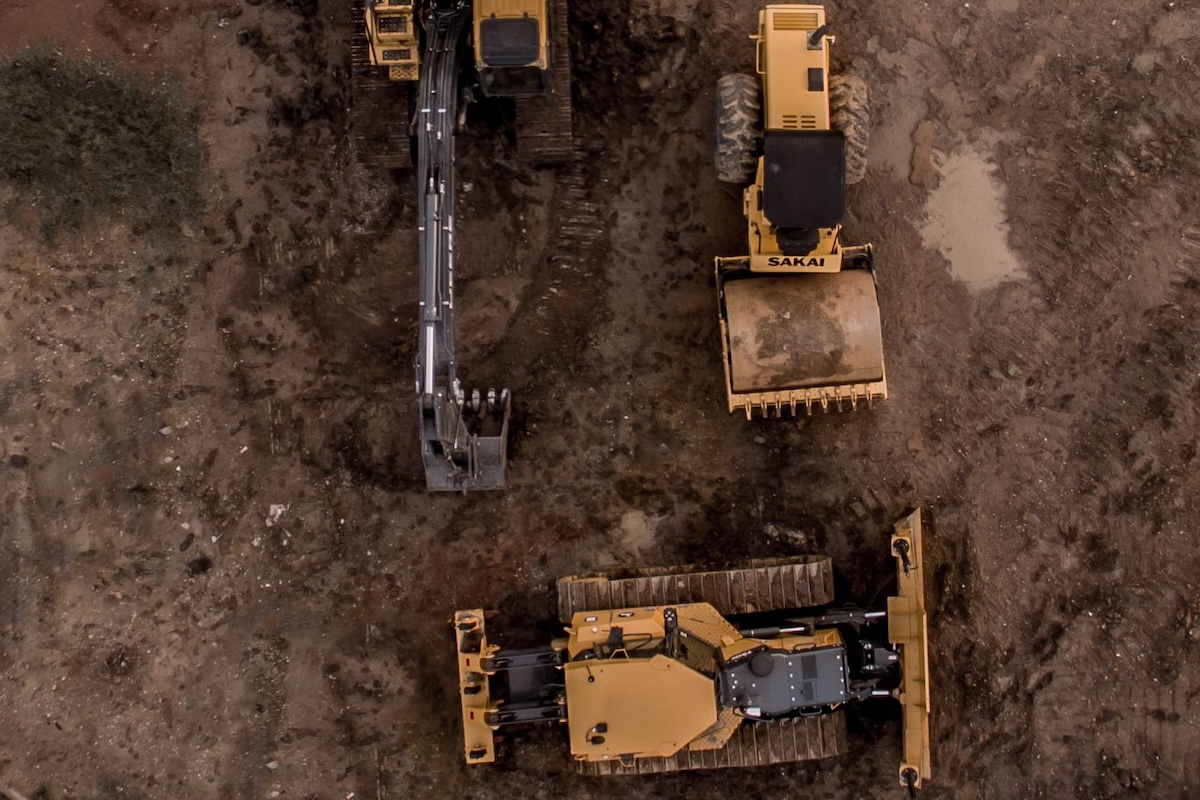
One recent, very successful, project is a noteworthy example of what that planning actually requires. The lot was small relative to the size of the home being built, stretched out to the lot lines, with a pool specified in the scope. On a site with more room, the pool might be sequenced toward the end of the project. Here, it had to be installed early, because once the house structure was up there would be no viable way to get the equipment to the backyard for the inground. The team had to build their way out, sequencing the work so that each completed phase preserved access for what came next, keeping retaining walls at bay long enough to maintain a staging area for concrete trucks and equipment.
All of it gets mapped in preconstruction using phased scheduling tools that allow the team to see how sequencing decisions ripple forward through the project before anyone sets foot on the site.
The honest answer is that preconstruction on a waterfront project doesn't have a reliable timeline, and that's the part clients can underestimate.
The build itself (framing, systems, finishes, everything that happens after the permit is in hand) runs on a timeline comparable to any custom home of similar scope. Nine to eighteen months is a reasonable range regardless of square footage. That part is plannable.
What precedes it is harder to predict. Conservation Commission review, wetlands filings, FEMA flood zone determinations, and town-specific permitting processes don't run on a builder's schedule. They run on their own schedule. A filing that moves smoothly through one town might sit considerably longer in another. Conditions are added and revisions requested. The process takes the time it takes with that many moving parts.
At OBB, preconstruction is treated as its own phase with its own disciplines, not as a waiting period before the real work begins. Clients who understand that going in are better positioned to make good decisions throughout.
Waterfront construction on Cape Cod is not a premium version of building inland. It is a category of work that requires more preparation, more regulatory navigation, more material precision, and more logistical planning than many clients anticipate when they first start thinking about it.
The builders who do it well are the ones who treat preconstruction as seriously as construction, who know the regulatory landscape well enough to design around it from the beginning, and who have built enough waterfront projects to know where the surprises tend to come from before they arrive.
At O'Neill Bowes, that experience is built into every waterfront project from the first conversation forward.
•••••
Planning a project on Cape Cod?
Call our office anytime to discuss: 508-419-2622
Waterfront construction on Cape Cod is not a premium version of standard residential construction. It requires a different level of preparation, regulatory navigation, and material precision across every phase of the project.
The permitting process for a waterfront project operates through the same regulatory framework as any residential build. The difference is how many of those regulations get activated and how extensively they apply.
Coastal soils on Cape Cod are not uniform, and what's beneath the surface on a waterfront site is not always apparent until the ground is opened. Foundation decisions follow from what the soil and flood zone designations actually require.
Salt air is corrosive in ways that compound steadily over time. The material decisions made during a waterfront build determine how a structure performs not just in year one but across decades of coastal exposure.
Waterfront lots on Cape Cod are often the most logistically demanding sites to build on. The constraints don't present themselves mid-project when planning has been done properly in preconstruction.
Timeline expectations are one of the most important things to establish correctly at the start of a waterfront project. The build phase is predictable. What precedes it often is not.