Building a home right on the water in Cape Cod is appealing -who wouldn't want the views, the sound of the ocean, and easy access to the beach? It's one of the top spots for waterfront living, combining classic coastal feel with high-end, lasting construction.
But the practical side kicks in fast. Rising sea levels intensify storm surges and flooding. Fierce Atlantic storms accelerate bluff erosion, with rates averaging 3–5 feet per year along exposed shores (and higher in recent years, up to 30–45 feet annually in spots like Monomoy). Unique soil conditions, including unexpected man-made fill or peat layers, can surprise even careful planners. Strict regulations from the Wetlands Protection Act, local Conservation Commissions, and evolving FEMA flood zones add further complexity. Increasing state and regional building code and energy regulations affect the design of exterior envelope systems. A harsh environment - with many coastal and winter storms, complete with corrosive salt-charged air - deteriorates many common building materials and systems that are used elsewhere in construction. As a result, waterfront construction on Cape Cod demands more than skill; it requires deep local knowledge and unflinching adaptability.
At O'Neill Bowes Building Company, with over 25 combined year of dedicated experience with high-end custom homes and renovations right here on Cape Cod, we turn these potential obstacles into manageable, durable, executable successes. We adapt to any material, design, or vision without imposing limits, always prioritizing transparent communication and exceptional client care to keep expectations aligned every step.
In this article, we'll walk through five common waterfront construction challenges on Cape Cod and share practical, field-tested ways we've solved them on real jobs.
Coastal erosion and bluff/soil instability rank among the most pressing waterfront construction challenges on Cape Cod. On Atlantic-facing shores and exposed south-shore sites, bluffs retreat rapidly due to relentless wave action, powerful nor'easters, and storm surges. Recent data from the Massachusetts Shoreline Change Project and local observations show average annual erosion rates of 3–5 feet along much of the Outer Cape, with hotspots like Nauset Beach or Monomoy areas seeing 5–6 feet or more in some years - and extreme events stripping significantly more overnight. Unstable soils compound the risk: unexpected layers such as peat, man-made fill from past development, or saturated muddy strata can undermine foundations, leading to settling, cracking, or costly retrofits if not addressed early.
This issue is distinctly Cape Cod-specific. The peninsula's coastline operates within the "river of sand" system - a dynamic longshore transport process where sediment moves northwest to southeast along the shore. Human interventions like the Cape Cod Canal's jetties (built in the early 1900s) interrupt this flow, trapping sand updrift and starving downdrift beaches of natural replenishment. Inlet migration, reduced sediment supply, and accelerating sea-level rise (faster in recent decades) exacerbate bluff retreat, creating a constant reshaping of the shoreline.
How do you prevent erosion on a Cape Cod waterfront home?
That begins with rigorous, site-specific assessments and layered stabilization strategies that balance protection, habitat preservation, and client vision.
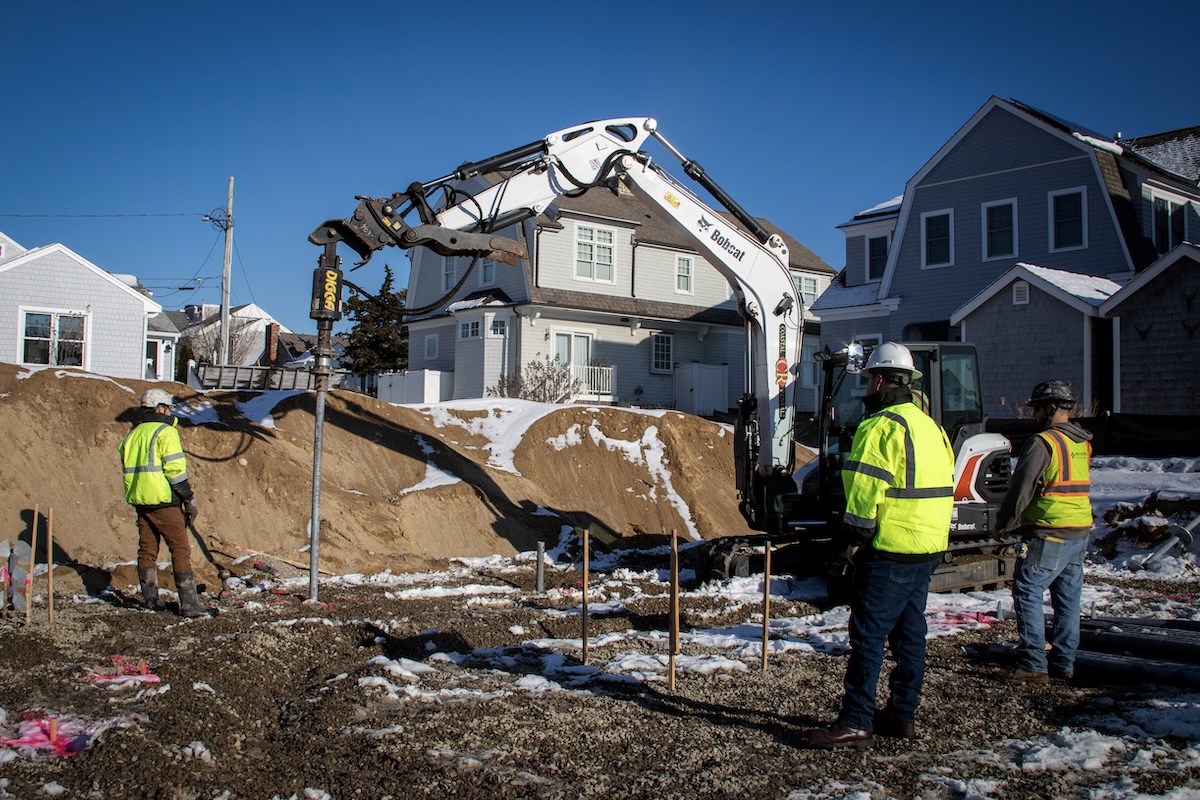
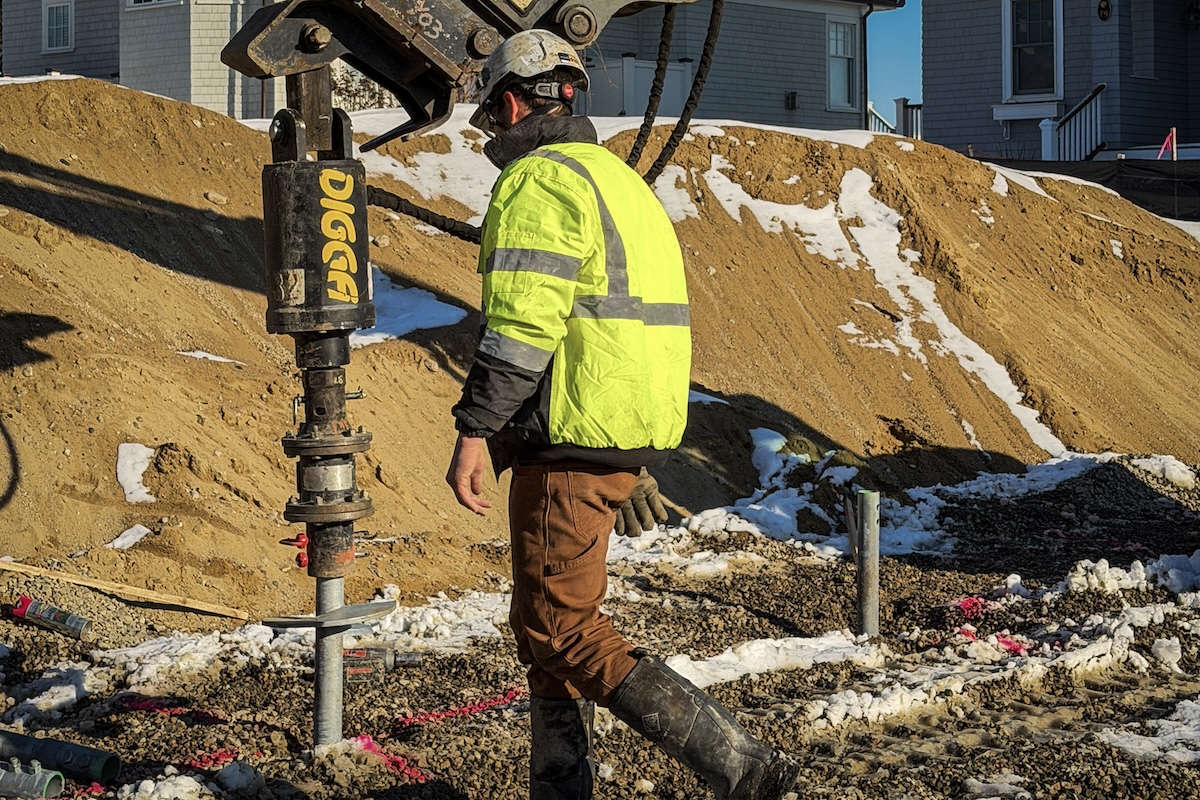
At O'Neill Bowes, we prioritize collaborative, proactive solutions. In a recent tear-down/rebuild in Mashpee (Popponesset), we encountered a highly unusual 30-inch peat bed - man-made from decades-old neighborhood development - overlying a homogenous muddy layer in the water table (elevation 6 ft, groundwater at 1.5 ft). A geotechnical engineer diagnosed the instability, and we collaborated with the project team and quickly revised the program to implement helical piles: site cleanup with a 12-inch crushed stone base, followed by drilling giant screw-like piles deep until refusal, leveling the tops, filling with concrete, and forming stable footings. This low-disturbance method reached solid bearing without extensive excavation, providing reliable support in challenging soils.
We also employ nature-based and regulatory-compliant tactics: native vegetation and dune restoration for long-term bluff armor, silt fencing/hay bales during construction to contain runoff, and strict adherence to town Conservation rules (often 50–100 ft buffers from mean high tide). Ongoing monitoring - weekly habitat checks, gutter/dry well systems, and storm washout prevention - ensures the site stays protected through seasons.
These approaches safeguard the project, environment, and client's investment while remaining fully adaptable to any design preference. Always client-collaborative, we walk through options transparently so you choose what fits your goals.
Strict regulatory and permitting hurdles are often the most time-consuming and anxiety-inducing aspect of waterfront construction on Cape Cod. Multiple overlapping layers of oversight govern nearly every project: the Massachusetts Wetlands Protection Act (MGL Ch. 131 Sec. 40), which protects bordering vegetated wetlands, salt marshes, and coastal banks; local Conservation Commissions that enforce town-specific bylaws and conduct public hearings; FEMA flood zone designations that dictate elevation and floodproofing requirements; zoning bylaws covering setbacks, height limits, lot coverage, and impervious surface ratios; and, in some cases, historic district commissions or Board of Health reviews for septic systems and environmental impact.
Cape Cod's regulatory landscape adds unique nuance. Each of the 15 towns has its own conservation bylaws, buffer zones (commonly 50–100 feet from mean high tide or wetland edges), and interpretation of state rules - meaning what is applicable in Barnstable may require extra steps in Mashpee or Chatham. Historic preservation overlays apply in older villages, while environmental impact studies or rare-species surveys can trigger additional scrutiny from state agencies like the Division of Fisheries and Wildlife. Public hearings introduce community input, which can extend timelines or shift project scope if neighbors raise concerns about views, habitat, or stormwater.
How does O'Neill Bowes navigate these complexities without derailing your dream?
We engage early and proactively in pre-construction planning, turning potential roadblocks into manageable steps.
Our approach starts the moment we walk the property: we get to work with the project team to flag buffers, gray areas, and outright impossibilities and their achievable alternatives, so clients understand realities before design begins. We connect them with trusted, area-specific civil engineers, designers, landscape architects, and other specialists who know the local Conservation Commission particulars and town nuances. We gauge each client's budget, goals, and disposition to match them with the right team, drawn from our established network of engineers, legal counsel and consultants who excel in specific towns for specific subject areas.
Timelines surprise many - permitting can take 6–18 months longer than anticipated depending on the regulatory compliant path - so we emphasize starting with surveys and civil engineering before diving into aesthetics. Throughout, our experience and communication takes front seat: weekly updates, clear explanations of what each rule means for their vision, and honest discussions of trade-offs. We never let compliance compromise the end goal; instead, we collaborate transparently to find compliant paths that preserve the client's dream - whether that's preserving an open layout, incorporating desired materials, or adjusting subtly without sacrificing quality or craftsmanship.
This early, guided involvement minimizes revisions, reduces stress, and keeps momentum toward a seamless build.
Flooding and FEMA flood zone requirements stand out as one of the most dynamic and non-negotiable challenges in waterfront construction on Cape Cod. Many properties fall into high-risk zones - AE (base flood elevation with wave action), VE (coastal high-hazard areas with velocity waves), or AO (shallow flooding) - where strict federal mandates govern minimum elevation above base flood elevation (BFE), velocity-resistant design, open foundations in velocity zones (to let water pass underneath), flood vents in enclosed areas below BFE, raised mechanical/electrical systems, and flood-resistant materials. Storm surge from nor'easters or hurricanes, combined with accelerating sea-level rise, increases flood probability year after year, leaving little margin for error.
These regulations evolve frequently, creating moving targets. FEMA periodically updates flood maps and requirements (such as recent adjustments to AE zone elevations or freeboard standards in some Massachusetts communities), which can shift compliance needs mid-project and add unexpected costs or design adjustments.
How does O'Neill Bowes balance FEMA compliance with your desired home design?
We deliver practical, code-smart solutions that future-proof the structure while preserving timeless luxury and client vision—no forced compromises on open layouts, views, or aesthetics.
Some methods we’ve used to solve this problem:
In one recent project, our pre-construction elevation report aligned perfectly with the town's initial approval. During the occupancy permit phase, however, the goalpost moved: the garage suddenly required +1 ft elevation (from 11 ft to 12 ft BFE). We adapted immediately - installing six additional flood vents. We needed to accommodate the municipality to get occupancy for the homeowner but required framers, sheetrock patching, copper flashing and new paint - without derailing the overall timeline or the client's desired open, luxurious feel. When applicable, we educate the homeowners who don’t want to raise their existing house to meet current flood heights on the FEMA 50% rule (for rebuilds under 50% of the home's value). This can potentially help them avoid full retrofits to newer standards and keep the project moving ahead at speed.
This client-collaborative mindset—full transparency on changes, multiple solution paths presented, and quick pivots—ensures compliance enhances rather than restricts the dream. We future-proof thoughtfully so your waterfront home remains resilient, beautiful, and uniquely yours for decades.
Site access, preparation, and logistics constraints can turn even well-planned waterfront projects into real logistical headaches on Cape Cod. Narrow winding roads - common in exclusive enclaves like New Seabury, Osterville, Chatham, Woods Hole, or Cotuit - make truck and equipment delivery tough. Limited staging areas force tight material storage, while environmental restrictions (e.g., Conservation Commission rules on vegetation disturbance or wetland buffers) restrict heavy machinery near the shoreline or sensitive areas. Clearing and foundation work often costs more because of these limits, and any delays from poor access can cascade into budget overruns or timeline slips.
These issues get amplified in waterfront settings: properties frequently sit at the end of private ways with Architectural Review Committee (ARC) or neighborhood oversight adding extra layers of approval for deliveries, parking, and site impact. Neighbors in close-knit communities can raise concerns about noise, traffic, or dust, turning logistics into a relationship management challenge as well. Many of them have gone through this themselves, so they're not often upset with the new build as much as frustrated with the situation itself.
How does O'Neill Bowes keep timelines and budgets on track despite these hurdles?
We rely on phased planning, specialized subcontractors, and creative staging—always with proactive communication at the core.
In a luxury New Seabury build, masonry and retaining walls required space for 30 vehicles, but the site and ARC rules limited us to 12 at a time. We adapted by partnering closely with the owner to secure temporary use of neighbor driveways, implementing a dedicated site foreman to manage parking, shuttle crews, and handle neighbor interactions. We built goodwill proactively—regular updates, kindness gestures (like bottles of wine to affected neighbors), and clear scheduling to minimize disruption. This kept complaints low, preserved relationships in a tightly monitored community, and ensured no delays.
Our broader playbook includes:
These strategies maintain momentum, control costs, and protect the client experience—turning potential chaos into smooth execution.
Waterfront sites on Cape Cod are among the most eco-sensitive environments, where regulations and best practices demand sustainable, low-impact approaches: native plantings to stabilize buffers, erosion-minimizing landscaping, low-impact drainage systems (such as dry wells and storm-managed gutters), energy-efficient mechanicals, and habitat-protective construction methods. At the same time, clients envision timeless luxury - open layouts, premium materials, custom features - without feeling constrained by "green" mandates or environmental trade-offs.
The real challenge lies in delivering both durability and sustainability while honoring the client's unique preferences and budget reality. Unforeseen requirements - like additional dry wells for stormwater or native vegetation buffers - can add costs that clients may initially undervalue, potentially straining trust if not handled carefully.
How does O'Neill Bowes strike this balance without compromising vision?
Through constant, transparent communication and a detail-oriented process that builds long-term trust.
We avoid generalities and work in specifics: clear line-item breakdowns ensure clients understand every necessary element upfront, so surprises are minimized and budgets stay as firm as possible. When unknowns arise (as they often do on waterfront sites), we provide full context, present multiple solution paths, and let the client choose - whether that's a more sustainable material option, a creative drainage workaround, or a phased approach that aligns with their goals and temperament.
This collaborative mindset turns potential friction into partnership. By managing expectations honestly and adapting flexibly to any design preference or material choice, we deliver homes that are resilient, environmentally responsible, and unmistakably the client's own - no forced compromises, just thoughtful, considered execution.
Waterfront construction on Cape Cod is undeniably challenging. From unpredictable soil layers and rapid bluff erosion to ever-shifting FEMA rules, complex permitting processes, tight site logistics, and the delicate balance of sustainability with luxury vision - these hurdles can feel overwhelming. Yet every one is solvable when approached with deep local expertise, proactive planning, and genuine collaboration.
O'Neill Bowes' focused experience on Cape Cod gives us the insight to anticipate issues before they become problems. More importantly, we bring an unwavering commitment to adaptability: we work with any material, design direction, or client preference without imposing a signature style or limiting possibilities. Whether it's helical piles for unstable soils, quick flood-vent adaptations mid-project, neighbor relationship management in restricted neighborhoods, or transparent line-item breakdowns for unforeseen costs - we tailor solutions to fit your dream, not ours.
What truly sets us apart is our client relations: full context on every situation, multiple solution options presented clearly, no hiding bad news, and constant communication that builds trust and keeps expectations aligned. We treat every challenge as a partnership opportunity, ensuring the final home feels unmistakably yours.
•••
Planning a project on Cape Cod?
Call Nick anytime to discuss: 774.487.0475