
Published:
April 8, 2026
Updated:
April 8, 2026

The Renovation Investments That Actually Hold Their Value on Cape Cod

Close-Up of Rustic Weathered Wooden Shingles
The investments that hold value in Cape Cod renovations aren't always the most visible ones. O'Neill Bowes walks through the shell, systems, and infrastructure decisions that experienced buyers price in – and why durability is as much a financial standard as a construction one.

Article Summary

What renovation investments hold their value best on Cape Cod?
The investments that hold value on Cape Cod are the ones that hold up under buyer and inspector scrutiny – a weather-tight envelope, proactively upgraded systems and septic, infrastructure decisions made with future ownership in mind, and rooms finished with quality materials that don't need to be revisited.
Why is Cape Cod a different market when it comes to renovation ROI?
Buyers at the high end of the Cape Cod market are typically second-home purchasers or pre-retirees with prior ownership experience and seasoned inspectors – a property carrying incomplete energy retrofits, aging mechanicals, or an undersized septic system doesn't receive the benefit of the doubt, it receives a renegotiation.
What does addressing the building envelope mean in a Cape Cod renovation?
Addressing the envelope means resolving the continuous barrier of walls, roof, windows, and foundation in full during a renovation rather than deferring it – on Cape Cod, salt air, freeze-thaw cycles, and coastal humidity make a compromised shell the fastest way to undermine every other investment in the home.
What is the Massachusetts Stretch Energy Code 50% threshold and why does it matter for resale?
Once a renovation crosses 50% of a home's assessed value, square footage, or scope, full energy code compliance applies to the entire structure – for pre-1990s homes on Cape Cod, triggering that threshold intentionally during a renovation already underway positions the home materially better for resale than cosmetic work alone.
What is the conduit play in Cape Cod home construction?
Installing conduits, chases, and utility sleeves for systems and spaces not yet being built – an in-law suite, EV charging, an additional HVAC zone – costs very little during a renovation and a great deal to retrofit later, and on Cape Cod it represents a form of adaptability that transfers value with the home.

Introduction

Every renovation begins with a wish list. On Cape Cod, at the high end of the market, that list tends to start in traditional places – the kitchen, the primary bath, the outdoor entertaining space. These are more than reasonable priorities, and they're often the right ones.

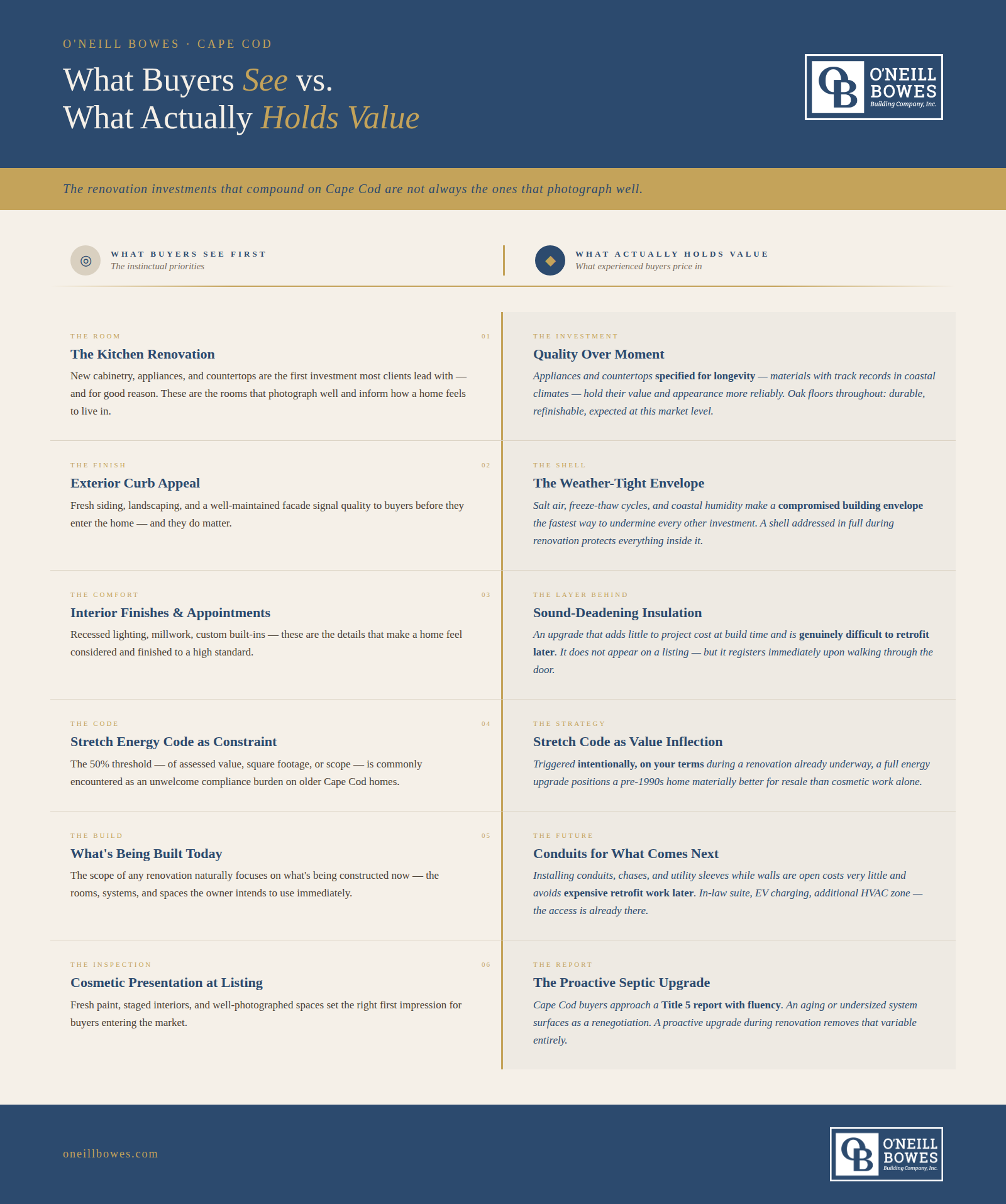
25+ years of combined experience building and renovating homes across the Cape has revealed other considerations to us as well, however. There are investments that hold a home's value on Cape Cod which may not always be the instinctual ones to lead with. The weather-tight envelope. The infrastructure decisions made during a build that make the next phase of ownership straightforward rather than costly. The mechanical and system upgrades that experienced buyers and their inspectors evaluate without sentiment.

This is not a guide to managing budgets or navigating surprises; it’s a guide to where investment compounds on Cape Cod, and why the most durable returns are often invisible at first glance.

Why Cape Cod Resale Is a Different Calculus

Cape Cod is often not a primary market. Common buyers at the high end here – second-home purchasers, pre-retirees, families making a generational commitment to a property – arrive with a different frame of reference than a buyer closing on their first home. They have owned before. They engage experienced inspectors. They understand what a Title 5 report is telling them and what deferred maintenance looks like once the walls are open.

That changes the investment calculus considerably.

A property that presents well but carries different iterations of previous renovations or energy/insulation upgrades, undersized septic, or mechanicals approaching end of service life does not receive the benefit of the doubt in this market. It prompts a renegotiation, sometimes a significant one. The finish work that photographs well does not always offset what a thorough inspection surfaces two weeks into a deal.

What holds value here is what holds up under that heightened level of scrutiny: a shell that is genuinely tight against coastal weather, systems with meaningful service life remaining, and infrastructure decisions made with future ownership already in consideration.

On Cape Cod, durability is not only a construction standard. It is a financial one.
The Envelope Comes First – Insulation, Windows, and the Shell

There is a pattern that appears too often in Cape Cod renovations: a beautifully appointed interior inside a shell that was left to be done later. New kitchen. Updated baths. Refinished floors. And somewhere behind the walls, an insulation package from the 70s, windows that have been losing the fight with coastal weather for a decade, and siding that was deferred because other priorities took precedence.

The shell is not a finishing detail. It is the investment that protects every other investment in the home.

On the Cape, this carries particular weight. Salt air accelerates material degradation in ways that inland climates do not. Freeze-thaw cycles work at joints, flashing, and any penetration in the building envelope (the continuous barrier of walls, roof, windows, and foundation that separates conditioned interior space from the elements) that was not detailed correctly. Coastal humidity finds its way into wall assemblies that are not properly protected. A compromised shell does not show immediately, it announces itself over years, in the form of moisture intrusion, diminished thermal performance, and finish work that begins to fail from the outside in.

When a significant renovation is underway, the case for addressing the envelope in full is straightforward: the access is already there, the disruption is already priced in, and the incremental cost of doing it correctly is a fraction of what retrofit work requires later.

One area worth specific attention is interior sound-deadening insulation, an upgrade that adds little to project cost at build time and is genuinely difficult to add later without significant disruption. It does not appear on a listing but it registers immediately upon walking through the door.

Experienced buyers notice it, and their inspectors note its absence.

The Timeless Rooms – Kitchens, Baths, and Floors

Kitchens and baths are where renovation budgets are most often concentrated, and for good reason. They are the rooms that inform how a home feels to live in and how a buyer evaluates the asking price. The opportunity, when renovating them thoughtfully, is to make choices that serve both goals at once: spaces that are genuinely enjoyable to live in today and that carry their value forward without needing to be revisited.

A distinction we encourage our clients to guide those choices is best quality for the budget at the moment. Appliances and countertops specified for longevity, materials and manufacturers with track records in this climate and at this market level. Cabinetry proportioned and finished to read as considered as well as meeting the desired style. Fixtures in baths that age gracefully which can also reflect the time they were installed. These are confident ones, and they’ll tend to photograph well when they’re installed as well as years later.

Throughout the home, oak floors deserve specific mention. Durable, refinishable, and expected by buyers in the Cape Cod market, they represent the kind of investment that appreciates in perception over time.

That is the standard worth building toward – a home where every era of investment is still earning its place.

The Stretch Code Threshold as a Value Inflection Point

Massachusetts Stretch Energy Code carries a threshold that many Cape Cod homeowners encounter as a constraint: once a renovation crosses 50% of a home's assessed value, square footage, or scope, full energy code compliance applies to the entire structure. For older homes, that can mean new windows, upgraded insulation, and mechanical systems brought to current standard: work that was not in the original plan and arrives as an unwelcome line item.

That framing is understandable. It is also incomplete.

For homes built prior to the 1990s, a significant portion of the Cape Cod housing stock, the more useful question is not whether crossing that threshold triggers compliance work. It is whether triggering it intentionally, on your terms and within a project already underway, positions the home materially better for resale over the next decade than cosmetic renovation alone would.

The answer, increasingly, is yes.

Homeowners at our end of this market are paying closer attention to energy performance than they were even five years ago. Utility costs, thermal comfort, indoor air quality, and the condition of mechanical systems are no longer secondary considerations; they inform offers. A home that has been comprehensively upgraded to current energy standards carries a different profile than one that presents well but runs on systems from another era.

When the work is going to happen eventually, and for most pre-1990s homes on Cape Cod, it will, the lowest-cost moment to do it is during a renovation already in progress. The access is open. The disruption is shared. The decision to cross that threshold and make the adjustments becomes a strategic one rather than an urgent one.

Future-Proofing Infrastructure – The Conduit Play

There is a category of investment that costs very little during a build and a great deal without it later. It does not appear in renderings or finish schedules. It will not be mentioned in a listing. It is also one of the more reliable indicators of a home that was built with its next twenty years in mind.

At O'Neill Bowes, we make a practice of installing conduits, chases, and utility sleeves for systems and spaces the homeowner is not building yet. An in-law suite that may come later gets its conduit run now, while the walls are open and the cost is marginal. An EV charging point gets its sleeve before the garage is closed. An additional HVAC zone gets its chase while the mechanical work is already underway.

The retrofit alternative – opening finished walls, rerouting mechanicals, running new lines through a completed structure – is disruptive and expensive in ways that are entirely avoidable.

Out here, where properties frequently move between seasonal and full-time use, where multi-generational ownership is common, and where the next owner's priorities may differ considerably from the current one's, adaptability is not a luxury consideration. It is a form of value that transfers with the home.

The Proactive Septic Upgrade

Septic is not a glamorous subject. It is, however, one that Cape Cod buyers and their inspectors approach with considerable fluency. A Title 5 report that surfaces an aging or undersized system does not typically produce a conversation about aesthetics or finishes, it produces a, sometimes substantial, counter.

The case for a proactive upgrade is straightforward. When a significant renovation is already underway, the site is disrupted, the contractor relationships are active, and the costs of associated work are already being absorbed. Addressing the septic system in that window (even when it is not yet strictly required) spreads the disruption across a project that is already bearing it and removes a variable that would otherwise require attention eventually.

For homeowners who intend to stay in the home for years before a sale is considered, the value is simpler still. A system that has been thoughtfully upgraded is one less thing to manage, monitor, or worry about, which, on Cape Cod, where seasonal conditions can complicate service and access, is worth considerably more than its line item suggests.

Conclusion

The homes that hold their value on Cape Cod share a quality that is difficult to photograph and easy to recognize. Every era of investment added something genuine to the structure – a tighter shell, a more capable system, a room finished with enough integrity that it does not need to be revisited. Nothing was deferred in a way that the next project would have to absorb.

That is the standard Tim O'Neill and Nick Bowes bring to every build or renovation they undertake. Not the appearance of quality, but the condition of a home that has been built thoughtfully from the inside out – where the envelope performs, the infrastructure anticipates, and the rooms that matter are done in a way that stands the test of time.

•••••

Planning a project on Cape Cod?
Call Nick anytime to discuss: 774.487.0475

Key Points

What renovation investments hold their value best on Cape Cod – and why do they differ from what clients typically lead with?

  • The instinctual renovation priorities – kitchens, baths, outdoor entertaining spaces – are legitimate investments when executed with quality and restraint, but they are most durable when they sit inside a shell and on systems that can carry them forward
  • The investments that hold value on Cape Cod are often the least visible ones: a weather-tight envelope, proactively upgraded mechanical systems and septic, and infrastructure decisions made with the next phase of ownership already in consideration
  • Buyers at the high end of this market arrive with prior ownership experience, seasoned inspectors, and fluency in what a Title 5 report or an incomplete energy retrofit is telling them – durability is evaluated without sentiment
  • Each era of renovation work carries a responsibility to the next one – rooms and systems finished with enough integrity that they do not need to be revisited are what distinguish a property that holds its value from one that accumulates deferred decisions
  • On Cape Cod, durability is not only a construction standard – it is a financial one, and the homes that reflect that understanding consistently hold their value better than those that prioritize appearance over condition

Why does the building envelope deserve priority in a Cape Cod renovation – and what does addressing it fully involve?

  • The building envelope – the continuous barrier of walls, roof, windows, and foundation that separates conditioned interior space from the elements – is the investment that protects every other investment in the home, and deferring it in favor of interior finishes reverses that logic
  • Salt air on Cape Cod accelerates material degradation in ways inland climates do not, freeze-thaw cycles work at every joint and flashing detail that was not correctly executed, and coastal humidity finds its way into wall assemblies that are not properly protected
  • A compromised shell does not announce itself immediately – it surfaces over years in the form of moisture intrusion, diminished thermal performance, and finish work that begins to fail from the outside in, by which point the remedy is significantly more disruptive than the original investment would have been
  • Interior sound-deadening insulation deserves specific attention – an upgrade that adds little to project cost at build time, is genuinely difficult to add later without significant disruption, and registers immediately upon walking through the door in ways that experienced buyers notice
  • When a significant renovation is already underway, the case for addressing the envelope in full is straightforward: the access is there, the disruption is priced in, and the incremental cost of doing it correctly is a fraction of what retrofit work requires at a later date

How should kitchens, baths, and floors be approached to ensure renovation investments hold their value on Cape Cod?

  • The opportunity in renovating kitchens and baths is to make choices that serve both goals at once – spaces that are genuinely enjoyable to live in today and that carry their value forward without needing to be revisited within a reasonable ownership horizon
  • Appliances and countertops specified for longevity – materials and manufacturers with track records in coastal climates and at this market level – hold their value and their appearance more reliably than choices driven by the moment
  • Cabinetry proportioned and finished to read as considered rather than current, and bath fixtures that age gracefully while reflecting the care of their installation, tend to photograph well at installation and remain assets years later
  • Oak floors deserve specific mention – durable, refinishable, and expected by buyers in the Cape Cod market, they represent an investment that appreciates in perception over time rather than requiring replacement as finishes evolve
  • On the Cape, where ownership tends to span decades rather than years, each era of renovation work has the opportunity to contribute something the home carries forward with integrity – the standard worth building toward is one where every investment is still earning its place

What is the Massachusetts Stretch Energy Code 50% threshold, and how can it represent a value opportunity rather than a compliance burden?

  • Massachusetts Stretch Energy Code applies full energy compliance to an entire structure once a renovation crosses 50% of assessed value, square footage, or scope – for older homes, that can mean new windows, upgraded insulation, and mechanical systems brought to current standard
  • The more useful framing for pre-1990s Cape Cod homes – a significant portion of the housing stock – is whether triggering that threshold intentionally, within a project already underway, positions the property materially better for resale than cosmetic renovation alone would
  • Buyers at the high end of this market are paying closer attention to energy performance than they were even five years ago – utility costs, thermal comfort, and mechanical system condition inform offers in ways that were less true a decade ago
  • A home comprehensively upgraded to current energy standards carries a different profile than one that presents well but runs on systems from another era – that distinction is increasingly legible to experienced buyers and their inspectors
  • When the work is going to happen eventually – and for most pre-1990s homes on Cape Cod, it will – the lowest-cost moment to do it is during a renovation already in progress, when access is open, disruption is shared, and the decision becomes a strategic one rather than an urgent one

What is the conduit play in Cape Cod home construction, and why does it represent one of the highest-ROI investments at build time?

  • Installing conduits, chases, and utility sleeves for systems and spaces not yet being built costs very little during a renovation and a great deal to retrofit later – it is among the most reliable indicators of a home built with its next twenty years in mind
  • An in-law suite planned for the future gets its conduit run while the walls are open and the cost is marginal; an EV charging point gets its sleeve before the garage is closed; an additional HVAC zone gets its chase while mechanical work is already underway
  • The retrofit alternative – opening finished walls, rerouting mechanicals, running new lines through a completed structure – is disruptive and expensive in ways that are entirely avoidable when the decision is made during original construction
  • On Cape Cod, where properties frequently move between seasonal and full-time use and multi-generational ownership is common, adaptability is not a luxury consideration – it is a form of value that transfers with the home regardless of how the next phase of ownership unfolds
  • This category of investment does not appear in renderings or finish schedules and will not be mentioned in a listing – its presence is felt in the ease and economy with which future owners can adapt the home to their priorities

Why should Cape Cod homeowners consider a proactive septic upgrade, and what is the case for doing it during a renovation already in progress?

  • Septic is a subject Cape Cod buyers and their inspectors approach with considerable fluency – a Title 5 report surfacing an aging or undersized system does not produce a conversation about finishes, it produces a renegotiation
  • When a significant renovation is already underway, the site is disrupted, contractor relationships are active, and the costs of associated work are already being absorbed – addressing septic in that window spreads the disruption across a project already bearing it
  • Upgrading proactively – even before strictly required – removes a variable that experienced buyers will price in at inspection and eliminates an eventual disruption that will happen on less convenient terms if deferred
  • For homeowners who intend to stay in the home for years before any sale is considered, the value is simpler still – a system that has been thoughtfully upgraded is one less thing to manage, monitor, or worry about, which on Cape Cod, where seasonal conditions can complicate service and access, is worth considerably more than its line item suggests
  • The proactive septic upgrade is the unglamorous investment that pays its returns quietly – in the ease of ownership, the confidence of a clean inspection, and the absence of a negotiation that did not need to happen

More Perspectives

A Lite Studio Production