Published:
April 28, 2026
Updated:
April 28, 2026

Meet The Team: Jim Stokes, BIM Manager & Supervisor

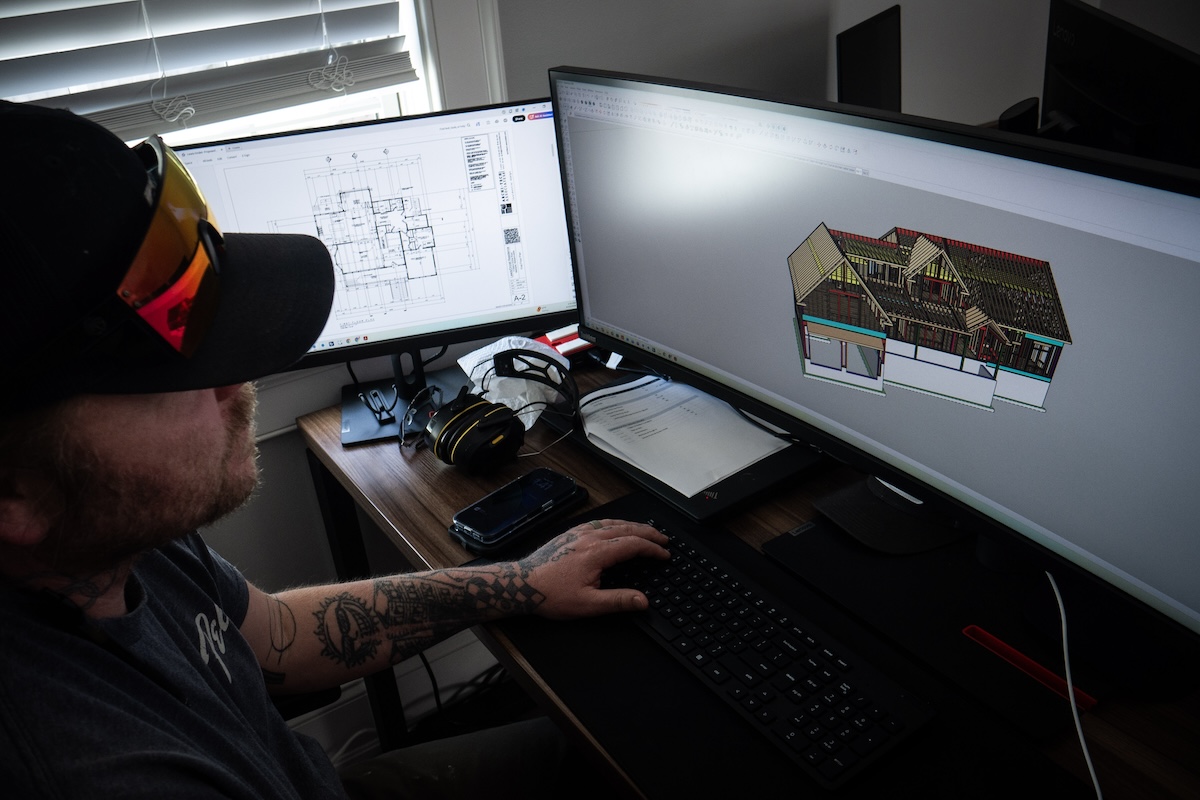
Jim Stokes, BIM Manager and Supervisor at O'Neill Bowes at his desk in the office in Osterville.
Jim Stokes framed custom homes on Cape Cod for twenty years before joining O'Neill Bowes. Now he builds every home twice: once in a proprietary BIM model, once in the field – catching structural issues before they become job-site costs. This is who he is and what he does before construction begins.

Article Summary

Who is Jim Stokes and what does he do at O'Neill Bowes?
Jim Stokes is OBB's Supervisor and BIM Manager — a twenty-year framing veteran who now models every custom home in a proprietary digital environment before construction begins. He splits his day between job-site rounds and office design work, keeping his modeling grounded in daily field reality rather than theory.
Who is Jim Stokes and what does he do at O'Neill Bowes?
Jim Stokes is OBB's Supervisor and BIM Manager — a twenty-year framing veteran who now models every custom home in a proprietary digital environment before construction begins. He splits his day between job-site rounds and office design work, keeping his modeling grounded in daily field reality rather than theory.
Where did Jim Stokes learn to build?
Jim grew up in central Florida where he started with tree work, landscaping, and cabinetry before moving into framing. In 2005, drawn by the reputation of Northeast craftsmanship, he relocated to Falmouth and immediately began working on Cape Cod homes — including structures built in the 1700s, assembled without nails or screws and still standing after centuries of New England winters.
What made Jim Stokes the go-to framer for the toughest jobs on Cape Cod?
Jim became known for framing the technical proofs — the complex and irregular roofs and structures that slow other framers down. His edge was arriving at a job site with the solution already built in SketchUp over the weekend, so a problem that would take a skilled crew a full day to figure out was resolved by noon on his sites.
What is BIM modeling and why does it matter for a custom home?
BIM stands for Building Information Modeling. At O'Neill Bowes, Jim models every home from the lowest point in the ground to the highest point in the roof before construction begins — every cut, dimension, structural member, connector, and fastener accounted for. In one recent project, this process caught over thirty issues before framing started, preventing an estimated six weeks of re-work.

There is a moment, early in a conversation with Jim Stokes, when you realize you are not talking to a typical soft-handed office hire. He'll be describing a structural drawing, something dense and technical, and then drop a line like "the math doesn't lie, the dimensions don't lie, there is no other way." Not as a boast. Just as a fact. The kind of fact you state when you've spent twenty years finding out what happens when you ignore it.

Jim is OBB's Supervisor and BIM Manager (Building Information Modeling). The title is precise but it undersells what he actually brings to a custom home project on Cape Cod. To understand that, you have to go back to Florida.

From Citrus Hills to Cape Cod

Jim Stokes grew up in Citrus Hills and Citrus Springs, a part of central Florida that became, in his words, a retirement mecca. The building that was happening there when he came of age was tract housing: single-story subdivisions cranking out five hundred to six hundred homes a year. He got his start the way a lot of young guys do, summer jobs in high school doing tree work and landscaping, then cabinetry, then handyman work. Roofing, siding, trim boards. Whatever needed doing.

By 2005 the subdivision boom had gone quiet and the work dried up. Jim was already deep enough into framing and carpentry that he knew what he wanted to do next. And he knew where to do it.

There's a piece of common knowledge in the construction industry that Jim had already absorbed: the best carpenters, and the most intricate work come from the Northeast. Exterior crown molding. Scrollwork gables. Shingle-style homes with complex wood detailing inside and out. In much of the country, even for high-end homes, the exterior is foam blocks glued to the wall with stucco sprayed over them. Aluminum rakes. Vinyl everything. The level of craft that is simply expected on a Cape Cod custom home, the kind of work O'Neill Bowes builds, is genuinely uncommon elsewhere.

Jim moved to Falmouth. He picked up a tree job for a couple of weeks to land on his feet, then almost immediately found work with a local remodeler. His first projects on the Cape were homes built in the 1700s. Structures assembled without nails or screws, pegged together, still standing after hundreds of New England winters. He was impressed. Then his first Nor'easter hit, and he was even more impressed.

Twenty Years in the Frame

From 2005 to 2025, Jim Stokes framed houses. He started as a sub-contractor, working with established crews across a range of companies. By 2020 he was being brought in to run those crews. Then he built his own crew. Then he became his own company, and he was the boss. But even then, when it was time to do the work that required real intricacy (building gables, setting ridges, framing the complex and irregular roofs that define Cape Cod architecture) Jim was still the one up on the staging doing it himself. He wore three hats: owner, structural planner, and builder when necessary.

That last part mattered to the people working with and for him. "You're not some guy yelling at them from the AC of the truck," as Jim puts it. When your crew watches you climb up and do the hardest part of the job yourself, a different kind of respect develops.

His bread and butter, the thing he became known for, was framing the technical proofs. The sections of a structure that some framers would slow down for, stand around on, figure out in real time. Jim was brought in specifically for those moments. It was his skill and his reputation, built across two decades and every kind of residential project the Cape throws at a builder.

What twenty years in the frame teaches you cannot be replicated in a classroom or learned from a set of plans. Jim can look at a 2D drawing and immediately know what will and will not work in three dimensions. He can read a structural detail and see whether a KD joist will dry and shift over time, whether an engineered I-joist carries a compaction factor that needs to be accounted for, whether an LVL beam is the right call for stability. He understands how wood behaves – not in theory, but in the specific, physical way that only comes from having watched it behave across hundreds of projects over many years.

"There's a collision there," he'll say, looking at a plan. "Big problem." And he'll say it before anyone is brought to the site and the meter starts running.

Which raises an obvious question: why move inside?

The Pull Toward the Office

Jim was in his late thirties and two decades into one of the most physically demanding trades in construction. Framing is hard on a body. That's part of it. But it's only part.

The other part is a skill Jim had been developing quietly alongside his field work, one that most framers simply don't have. And to understand where that skill came from, you have to understand one of the things that Jim does for fun.

The Computer in the Background

In his late twenties and early thirties, Jim Stokes was a serious gamer. Not casually serious – the kind of serious that leads you to build your own PC from component by component so you can run games at the highest possible quality settings. It's an expensive hobby and Jim needed a way to fund it.

The solution he arrived at was elegant: he would use the same technology he was gaming on to become better (read more efficient) at his job. Instead of showing up at a complex roof framing and standing around figuring it out on site, something was always capable of doing, but which burned time and kept his crew waiting, he started designing the solution in SketchUp over the weekends. By the time he arrived at the job Monday morning, the answers were already in his pocket.

The effect on his crew was immediate. A job that would take a skilled framer a day to figure out was done by noon on Jim's sites. Not because he was working faster, but because the work had already been done. He had the answers. The crew stayed in motion.

That's what launched his reputation as the go-to guy for the toughest framing problems on Cape Cod. He was already the person people called for complex and irregular roofs; The SketchUp work made him the person who showed up with the problem already solved.

Jim hasn't stopped there. He took classes in AI prompting and coding. He built an in-house application for O'Neill Bowes to manage and coordinate jobs. And he rebuilt/enhanced the SketchUp app itself, developing proprietary custom applications within the software to automate functions that would otherwise require modeling individually, piece by piece. What he runs today is not the SketchUp you can download. It is a purpose-built precision environment that reflects twenty years of field knowledge and a mind that has never been content to use a tool the way it was shipped.
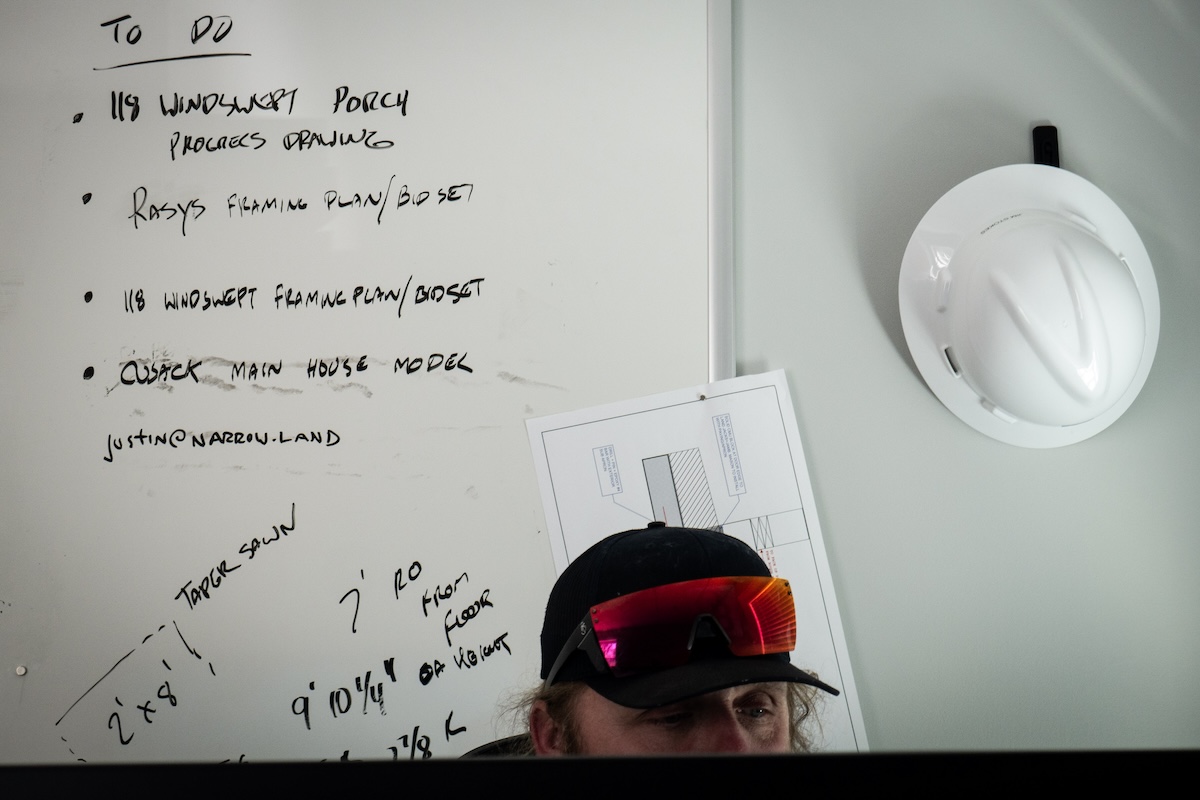
Buried behind one of his monitors, Jim spends most of his day solving problems before they can wreak havoc.

What Jim Does Before the First Shovel Touches Down

Jim's day starts at 6:45am making the rounds at his job sites. By 10:00 he's in the office. From 10:00 to 2:00 he's at his desk. Then he's back out for closing rounds. It's a rhythm that keeps one foot in the field and one foot in the planning work, and it's the reason his office output carries the weight it does. He's not modeling from theory. He was on the site three hours ago.

For a prospective client building a custom home with O'Neill Bowes, what Jim produces before construction begins is something most builders can't. He models the entire structure, from the lowest point in the ground to the highest point in the sky, in his proprietary SketchUp environment. Every cut. Every dimension. Every structural member, steel connector, anchor bolt, and fastener accounted for. The lumber and trim are calculated down to the board-foot before a single tree comes down on the site.

Clients often visit the office to see their models and meet with the team. One in particular met with Tim, Nick, and Jim to review her home, which looked straightforward from the outside, and was not expecting what she found in the guts of the structure. Inside the model, it was surprisingly complex with a significant number of structural members intersecting throughout. Jim had already flagged and resolved several interferences and collisions, conditions where components would have conflicted with each other in ways that wouldn't become visible until they were being built. Every one of those issues, sorted out at a table, before the first shovel hit the ground.

This is what BIM modeling produces: not a rendering, not a visualization for presentation purposes, but a construction document of such precision that OBB's framers now work from Jim's set of plans as their primary reference. In one recent home, the modeling process caught upwards of thirty individual issues before framing began. Resolving those issues on a job site, in real time, mid-construction, would have added an estimated six weeks of re-work. At the cost of custom residential framing, that is a number that lands hard.

Jim also collaborates directly with the architects whose plans OBB builds from, flagging discrepancies, proposing solutions, and getting sign-off on changes before they affect the schedule. His goal is to design the architects vision with in the most effective, efficient, pro-active manner possible.It is a level of pre-construction coordination that most residential builders don't attempt and most clients never see, because by the time they're watching the frame go up, the hard work is already done.

What Drives Him

Ask Jim Stokes what he wants and he'll tell you plainly: he wants to be the best at what he does. He wants to be the person everyone comes to when the problem is hard. And beyond his own work at OBB, he wants to push BIM modeling into the residential construction world more broadly, because right now it's done routinely in commercial construction and very seldom in residential, and he believes that gap is costing the industry, and the people building homes, more than they know.

Future-proofing is one of the things that drives him. The way he models a structure, a home can be framed to accommodate things that aren't being built yet. An addition that's ten years away. An electrical upgrade. A mechanical change. The framing can be designed to allow for it, so that when the time comes, the house is ready.

"The math doesn't lie. The dimensions don't lie. There is no room left for interpretation."

For the people building a custom home with O'Neill Bowes, that standard of certainty, established before the first nail is driven, is what Jim Stokes brings to every project.

•••

To learn more about what Jim's BIM process means for your custom home project, visit oneillbowes.com or call us anytime.

Key Points

What does Jim Stokes's background in the field mean for clients building a custom home with O'Neill Bowes?

  • He reads plans the way a builder reads them, not the way a drafter does. Jim can look at a 2D drawing and immediately identify what will and will not work in three dimensions – a perceptual skill that only develops after years of watching designs meet job-site reality.
  • He understands how building materials actually behave over time. He knows the difference between a KD joist that will dry and shift, an engineered I-joist with a compaction factor to account for, and an LVL beam that will hold stable – and he designs accordingly.
  • He earned the respect of crews by doing the hardest work himself. Even as a company owner, Jim was still the one up on the staging setting ridges and building gables. That credibility with tradespeople carries directly into how his plans are received and executed.
  • He came up through a construction culture defined by craft. Moving from Florida's foam-block-and-stucco building world to Cape Cod's tradition of exterior crown molding, scrollwork gables, and shingle-style detailing gave Jim a specific education in what genuine quality looks like — and what it takes to produce it.
  • He has framed every kind of project the Cape throws at a builder. Two decades of residential custom construction across every scale and complexity level means Jim has seen, and solved, the full range of problems that come with building in this region.
  • His field experience makes his modeling more accurate than software alone can produce. When Jim draws a structural connection in his model, he has built that connection. He knows where it is vulnerable, how it behaves under load, and what it looks like when it is executed correctly versus adequately.

How did Jim Stokes develop his proprietary SketchUp environment and what makes it different?

  • It started as a practical solution to a real job-site problem. Rather than arriving at a complex framing job and standing around while the crew waited for answers, Jim began designing the solution over the weekend in SketchUp so the work was done before anyone arrived on Monday.
  • The hobby funded itself by making him dramatically more efficient. A job that would take a skilled framer a day to work through was resolved by noon on Jim's sites, because he had already done the thinking. That efficiency became his reputation.
  • He didn't stop at using the software — he rebuilt it. Jim developed proprietary custom applications within SketchUp to automate functions that would otherwise require modeling piece by piece. What he runs today is a purpose-built precision environment, not the version anyone can download.
  • He has continued to invest in his technical education. AI prompting classes, coding courses, an in-house job coordination application built for O'Neill Bowes — Jim treats learning as a permanent condition of doing the work well, not a one-time credential.
  • His tool is informed by field knowledge no software company can replicate. The decisions built into his custom environment reflect twenty years of watching how structures are actually assembled, where problems arise, and what precision looks like at the level of a fastener or an anchor bolt.
  • It is, at this point, genuinely proprietary. No other residential builder on Cape Cod is running what Jim runs. That is not a marketing claim — it is the result of a specific combination of field experience and technical investment that took two decades to develop.

What does Jim Stokes's BIM process produce for a client before construction begins?

  • A complete digital model of the home, from foundation to roofline. Every structural member, steel connector, anchor bolt, and fastener is accounted for before a single tree comes down on the site.
  • Material calculations down to the board-foot. Lumber and trim are fully quantified in the model, which tightens procurement, reduces waste, and removes the guesswork that causes mid-project cost surprises.
  • Structural conflicts identified and resolved at a table, not on a job site. Interferences between components that would otherwise surface during framing — where fixing them is expensive, disruptive, and time-consuming — are caught in the model where the cost of resolution is zero.
  • A set of plans precise enough for framers to work from directly. O'Neill Bowes's framing crews now use Jim's plans as their primary construction reference, which speaks to the level of dimensional accuracy and detail his models carry.
  • A coordination layer between OBB and the project architect. Jim works directly with architects to flag discrepancies, propose solutions, and get sign-off on changes before they affect the schedule — a level of pre-construction collaboration that most residential builders don't attempt.
  • Documented certainty before the first dollar of construction labor is spent. In one recent project, Jim's modeling process caught over thirty individual issues before framing began, preventing an estimated six weeks of re-work at custom residential framing rates.

Why is BIM modeling rare in residential construction and what is Jim Stokes doing about it?

  • BIM has been standard in commercial construction for years. Large-scale commercial projects — office buildings, hospitals, institutional facilities — have used Building Information Modeling to coordinate complex, multi-trade builds for decades.
  • Residential construction has been slow to adopt it. The reasons are a mix of scale, cost, and habit. Most residential builders work from 2D architectural plans and resolve conflicts in the field, which is slower and more expensive but familiar.
  • Jim believes that gap is costing the residential industry — and homeowners — significantly. Re-work, schedule overruns, and mid-construction design changes are among the most predictable costs in custom home building. BIM modeling eliminates most of them before they start.
  • He is building a track record at OBB that demonstrates what residential BIM can produce. Five full framing models completed, over thirty issues caught in a single project, six weeks of re-work prevented — these are not projections, they are outcomes from completed work.
  • His goal is to advance BIM into residential construction more broadly. Jim sees his work at O'Neill Bowes as proof of concept for a standard that the industry has not yet adopted — and he intends to push it forward.
  • Future-proofing is part of what the model enables. Jim can design framing to accommodate additions, electrical upgrades, and mechanical changes that aren't being built now but may be needed later — so that when the time comes, the house is structurally ready for it.

What should a prospective custom home client understand about what happens before O'Neill Bowes breaks ground?

  • The home is fully built once before it is built for real. Jim's BIM model is not a visualization or a presentation tool — it is a construction document, built to the precision of the finished structure, that resolves every major structural decision before labor begins.
  • Problems that would surface during framing are found and fixed at zero cost. Structural interferences, dimensional conflicts, and coordination issues between trades are far cheaper to resolve in a model than on a job site. Jim's process systematically eliminates them before the meter starts running.
  • The client can see and understand the structure of their home before it exists. Unlike a set of architectural plans, a BIM model is accessible to someone without a construction background. Clients can see the complexity of what is being built and understand the decisions being made on their behalf.
  • The architects stay in the loop throughout. Jim coordinates changes with the project architect, getting sign-off before anything is modified, which protects the design intent and keeps the professional record clean.
  • Nothing about the material or structural scope is left to estimation. Lumber, trim, connectors, fasteners — all of it is quantified in the model before procurement begins. That level of specificity removes a significant source of budget variance.
  • The precision established in pre-construction carries through to every phase. Because the framing crews work from Jim's plans, the accuracy of the model becomes the accuracy of the build. What is designed in the model is what goes up in the field.

What does Jim Stokes's dual role — field supervisor and BIM manager — mean for an O'Neill Bowes project?

  • He is on the job sites every morning before the office opens. Jim's day begins at 6:45am with site rounds, which means his modeling work is always informed by what is actually happening on active projects, not by plans alone.
  • He brings a foreman's instincts to a designer's tools. The combination of daily field presence and proprietary modeling capability is rare — and it means that what Jim produces in the office reflects the realities of what the field can execute.
  • He closes each day with another round of site visits. Morning rounds at 6:45am, office work from 10:00am to 2:00pm, closing rounds in the afternoon — the rhythm keeps him embedded in both worlds simultaneously.
  • His authority on the job site backs his authority in the model. Crews respect Jim's plans in part because they respect Jim — because they have watched him climb the staging and do the hardest work himself. That credibility translates into how precisely his plans are followed.
  • He can catch a field problem and model the solution the same day. The close loop between site and office means that conditions discovered during construction rounds can be addressed in the model and resolved before they become schedule issues.
  • For a client, it means the same mind is overseeing both the precision of the plan and the reality of the build. That continuity — one person with deep accountability across both domains — is a quality control layer that most builders don't have.

More Perspectives

A Lite Studio Production