Most renovation budgets start spiraling before a single drawing is made - because priorities are fuzzy. Homeowners walk in with a loose vision: “We want a bigger kitchen, maybe an extra bedroom, a screened patio, better flow for entertaining.” The inspired architect does their best to articulate that description, sketches beautiful plans, and the whole team rallies around the dream. Then reality hits. The budget can’t stretch that far. The land or regulations make half the ideas impossible. Redesigns pile up, fees keep coming, timelines drag, and what began as excitement turns into frustration and second-guessing.
This is where almost every overrun begins. Without a clear, prioritized list of what truly matters, the project becomes a wish list instead of a plan. We’ve watched clients spend weeks (sometimes months) on drawings for features they ultimately can’t afford or permit, only to scale back and feel like they’ve wasted time and money. On Cape Cod especially, where zoning, wetlands buffers, septic rules, and energy code thresholds add extra layers of constraint, starting without clarity is even riskier.
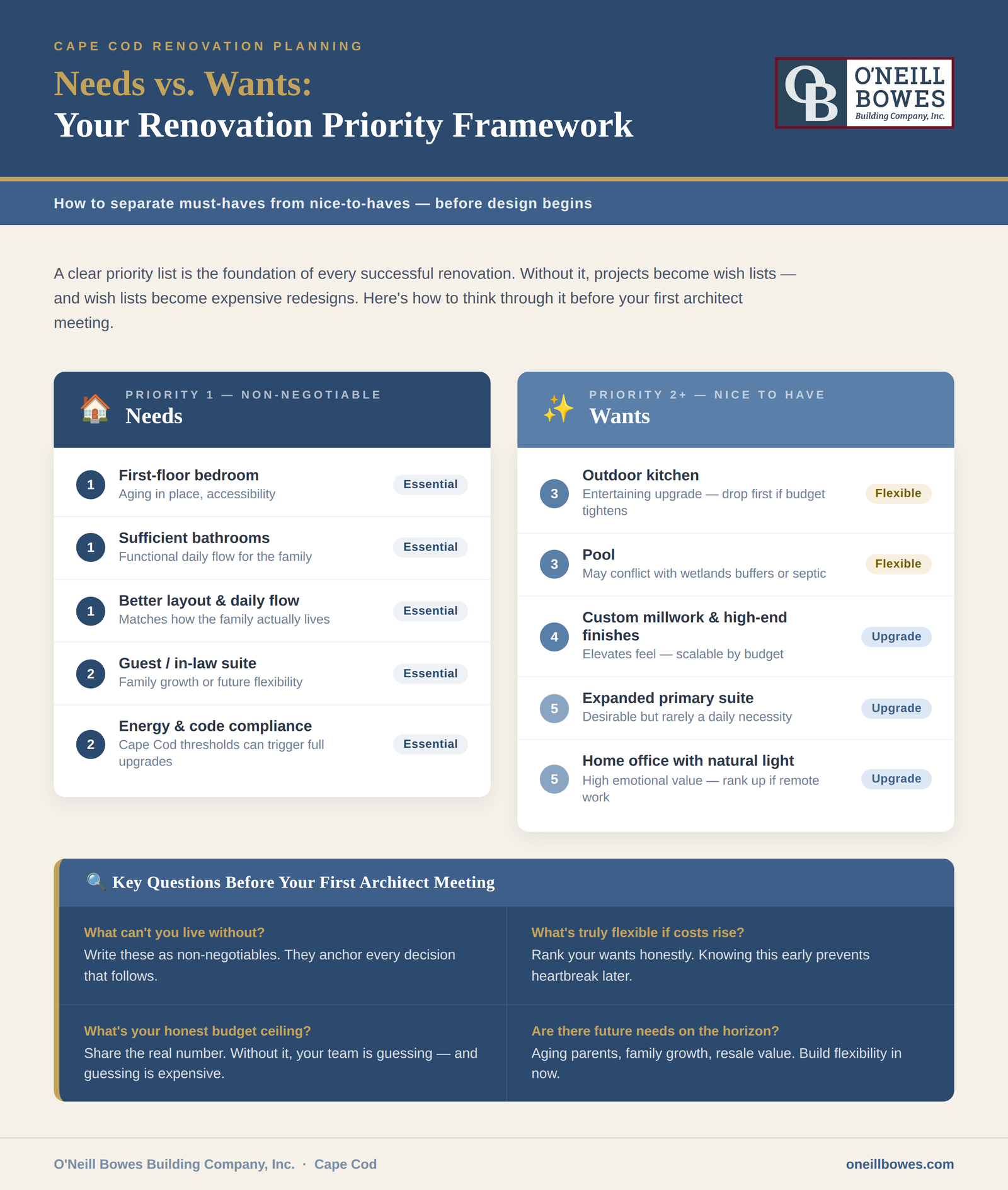
A clear Needs vs. Wants list is the foundation of every successful renovation we guide at O'Neill Bowes. It’s the very first step we take on every project — before any serious design work begins. Needs are non-negotiable: a first-floor bedroom for aging in place, enough bathrooms for the family, better daily flow. Wants are the extras: outdoor kitchen, pool, custom millwork, high-end finishes. We write them down, rank them by priority, attach rough cost ranges based on real Cape Cod projects, and use the list to guide every decision that follows.
In this article, we walk you through exactly how to build that list yourself:
This isn’t theory — it’s the practical tool we use on every Cape Cod renovation to keep budgets realistic, projects on track, and clients focused on what truly matters.
Most renovation budgets start spiraling before a single drawing is made — because priorities are fuzzy. Homeowners walk into the process with a loose vision: a bigger kitchen, an extra bedroom, a screened patio, better flow for entertaining. The architect gets excited, sketches beautiful plans, and the whole team rallies around the dream. Then reality hits. The budget can’t stretch that far. The land or regulations make half the ideas impossible. Redesigns pile up, fees keep coming, timelines drag, and what began as excitement turns into frustration and second-guessing.
This is where almost every overrun begins. Without a clear, prioritized list of what truly matters, the project becomes a wish list instead of a plan. We’ve watched clients spend weeks (sometimes months) on drawings for features they ultimately can’t afford or permit, only to scale back and feel like they’ve wasted time and money.
Common traps include underestimating seemingly simple changes. Moving a sink from one place to another sounds easy - until it requires upgrading the entire plumbing system. Adding recessed lighting can reveal an electrical panel that’s no longer up to code, triggering a full rewire. Stretch energy codes can be one of the largest hidden pitfalls, with certain trigger points that could require the entire structure to be brought up to current energy standards. Co-founder Tim O’Neill is passionate about this issue and serves on the Homebuilders Association Government Affairs Committee and the Town of Barnstable Planning Board, so we see it often: a modest kitchen redo or couple of bathrooms suddenly turns into a tear-down-level project.
Cape Cod makes these assumptions even riskier. Land constraints, wetlands buffers, septic rules, historic overlays, and FEMA zones add layers of complexity that generic wish lists rarely account for. Starting without clarity is the most expensive mistake of all — building toward something that was never achievable.
Building a renovation priority list isn’t complicated — it’s just deliberate. The goal is to turn a fuzzy vision into a ranked, realistic plan before you meet your architect or builder. When you do this step right, you give your team something concrete to work from instead of a wish list that gets expensive fast.
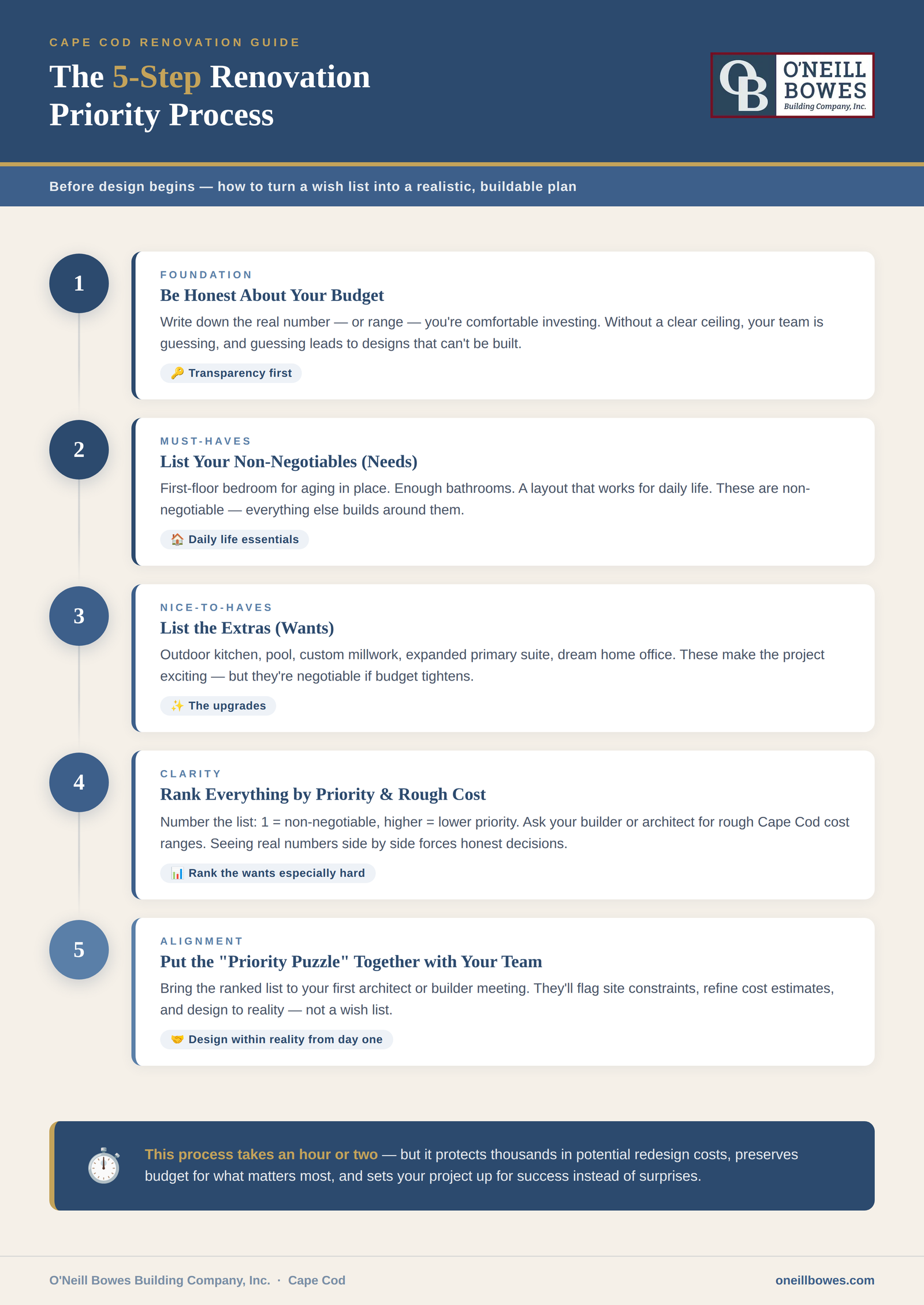
Here’s the simple 5-step process we walk every Cape Cod client through early in preconstruction:
Transparency is essential — and it starts with you. Write down the real number (or range) you’re comfortable investing. Clients sometimes hesitate because they worry it will limit creativity, but the opposite is true: without a clear budget ceiling, we’re guessing, and guessing leads to designs that can’t happen. An honest number lets your team guide you toward what’s actually achievable.
These are the things you can’t live without - the must-haves that will make daily life better or more practical. Examples: a first-floor bedroom for aging in place, enough bathrooms so mornings aren’t chaotic, better flow for family gatherings, or a layout that actually works with how you use the home. Be specific and realistic. These are the foundation - everything else builds around them.
Now write down the nice-to-haves: the outdoor kitchen, pool, custom millwork, high-end finishes, expanded primary suite, or that dream home office with natural light. These are the upgrades that make the project exciting, but they’re not essential. The more wants you add here, the clearer it becomes where trade-offs might be needed later.
Number the list: 1 = non-negotiable, higher numbers = lower priority. For each item, jot a rough cost range based on real Cape Cod projects (your builder or architect can help here). This step forces clarity - seeing outdoor kitchen prices next to first-floor bedroom prices makes priorities concrete. Rank the wants especially hard: if budget tightens, which ones drop off?
Bring the ranked list to your first architect or builder meeting. They’ll help refine cost estimates, flag regulatory or site constraints (e.g., wetlands buffers limiting a pool), and start building a plan that fits both your priorities and reality. The list becomes the guide - no more drawing unbuildable dreams.
This process takes an hour or two but protects thousands in potential redesign costs, preserves budget for what matters most, and maximizes investment efficiency. By getting wants and needs in place early - with budget transparency front and center - you set your project up for success instead of surprises. It’s the difference between a renovation that feels aligned with your life and one that feels like a compromise.
Before you ever sit down with an architect, take a quiet hour or two to answer five key questions honestly. These aren’t just icebreakers - they’re the filter that turns a vague dream into a realistic project. Skipping this step is how wish lists become expensive redesigns. Answering them clearly lets your architect (and builder) start from truth, not assumptions.
These questions force clarity before the first architect meeting. When you bring a ranked, realistic list - with budget parameters attached - your team can design within reality from day one. Client openness lets us guide priorities effectively, keep costs in check, and deliver a home that truly fits your life.
Once you have a clear, ranked Needs vs. Wants list with budget parameters attached, the real magic happens: it becomes the guiding document for your entire team. The architect no longer designs in a vacuum - they work within real constraints from day one. No more beautiful renderings of unbuildable features that get scrapped later. The civil engineer can immediately flag zoning, septic, or wetlands issues that would derail a wish-list plan. The builder (us) can provide accurate cost ranges and spot potential ground balls early. Everyone aligns on the same realistic scope before a single line is drawn.
This protects against the most expensive mistake: redesign fees and wasted time. We've seen projects where the architect spent weeks on layouts unaware of the impervious surface limits or septic placement - only to have to start over once the civil engineer weighed in. Those revisions add up fast: extra drafting hours, multiple rounds of changes, extended timelines. A clear priority list eliminates most of that back-and-forth.
The list keeps the project focused and collaborative. It forces honest conversations: "This want pushes us over budget - which need do we protect?" or "This feature triggers a code upgrade - is it worth the cost?" Early list + budget talk avoids the spiral we see so often: building toward something that was never achievable. Instead, your team designs a home that fits your life, your budget, and the realities of Cape Cod - maximizing investment efficiency, preserving budget for what matters most, and reducing stress.
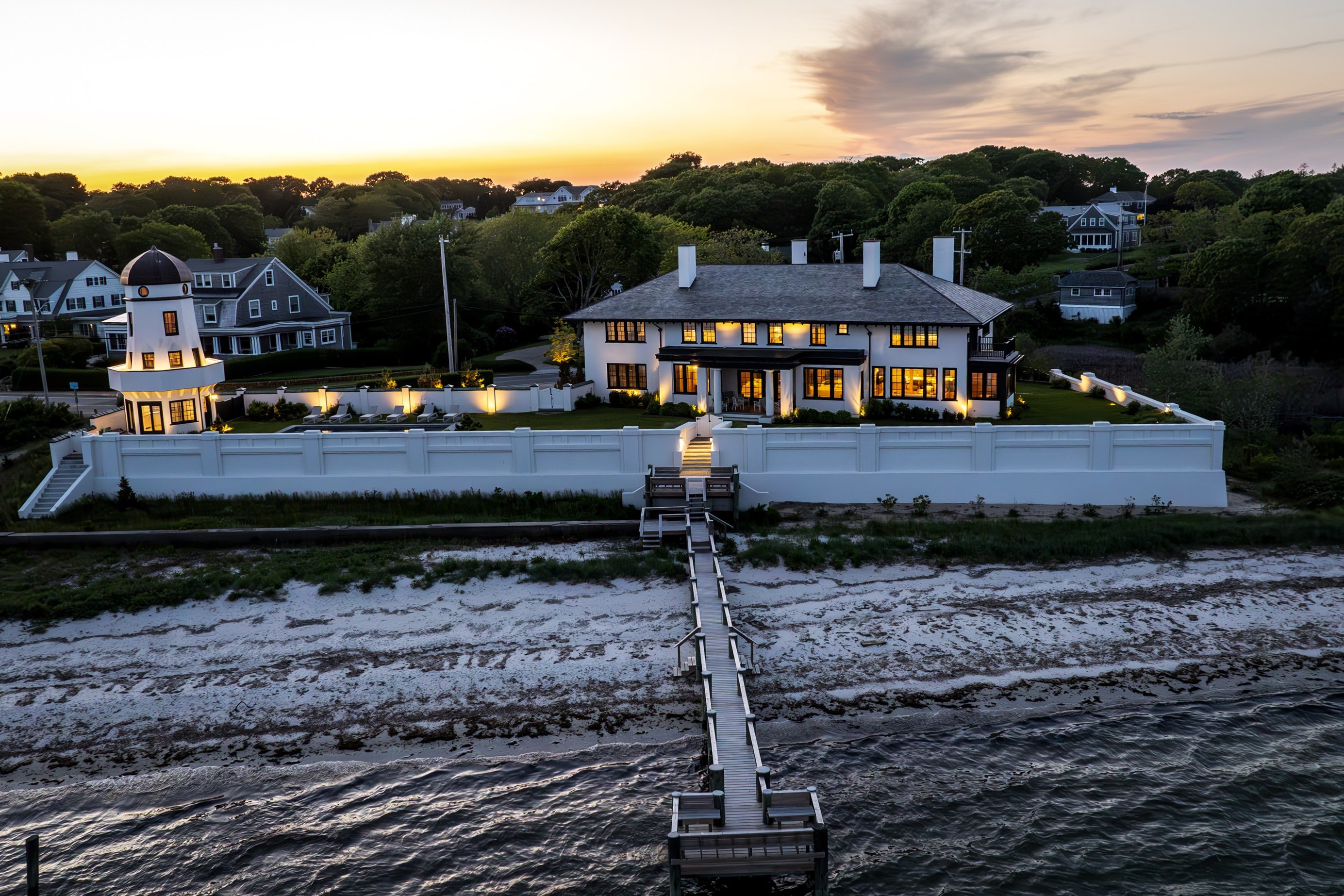
Clear priorities are the difference between a renovation that feels aligned with your life and one that spirals into compromises, delays, and extra costs. A simple Needs vs. Wants list - ranked, budgeted, and honest - turns vague dreams into a realistic plan before design even begins. It saves thousands in redesign fees, shortens timelines, and keeps your team focused on what truly matters instead of chasing unbuildable ideas.
At O'Neill Bowes Building Company, this exact process is the foundation we use on every Cape Cod renovation and addition. We start with your priorities, map them against real budgets and site constraints, and guide the project from there - no guessing, no wasted effort. The result is a home that fits your life today and tomorrow, without the common frustrations.
•••
Planning a project on Cape Cod?
Call Nick anytime to discuss: 774.487.0475